
API Changelog Best Practices: A Structured Guide for API Teams
API changelog best practices are the concrete rules and conventions that make a changelog genuinely useful rather than a formality: consistent semantic versioning labels, explicit breaking-change callouts, a predictable publication cadence, and hard links from each entry to the versioned reference docs that describe the changed endpoints. Apidoke supports this workflow natively through per-project version history and one-click public publishing of versioned API Blueprint docs.
- Every changelog entry should carry a semver-aligned version label (e.g.,
v2.4.0), a date, and a severity tag (BREAKING,DEPRECATED,ADDED,FIXED). - Breaking changes deserve their own dedicated section, always listed first, and must name the specific endpoint, HTTP method, and what exactly changed.
- Changelog entries should link directly to the versioned reference doc for each affected resource, so developers can read the new contract without searching.
- A predictable cadence (weekly, per-release, or on each merged PR) lets consumers know when to check for updates, which reduces support requests.
What makes a changelog different from release notes?
Release notes are marketing-facing summaries aimed at a broad audience. A changelog is an engineering-facing, chronological record of every discrete change to an API contract, indexed by version. The target reader is a developer who already depends on your API and needs to know, quickly, whether they have to change anything on their end. That distinction should drive every structural decision you make.
Aligning your changelog with semantic versioning
Semantic versioning (semver) uses a three-part label: MAJOR.MINOR.PATCH. Applied to an API, the mapping is clear and should appear verbatim in every changelog heading.
| Version segment | When to increment | Changelog severity tag | Example |
|---|---|---|---|
| MAJOR | Any breaking change: removed field, changed response shape, renamed endpoint, new required parameter | BREAKING | v3.0.0 removes GET /users/:id/legacy |
| MINOR | Backwards-compatible additions: new optional field, new endpoint, new optional query parameter | ADDED or DEPRECATED | v2.5.0 adds POST /sessions/refresh |
| PATCH | Bug fixes that do not alter the public contract: corrected HTTP status code, fixed error message text | FIXED | v2.4.1 corrects 200 to 201 on POST /orders |
The semver specification is published at semver.org and is the canonical source if your team needs to settle a disagreement about when to bump a segment. The key discipline is to never bury a MAJOR change inside a MINOR release to avoid alarming consumers. That practice destroys trust faster than any breaking change itself.
How should breaking changes be formatted in a changelog?
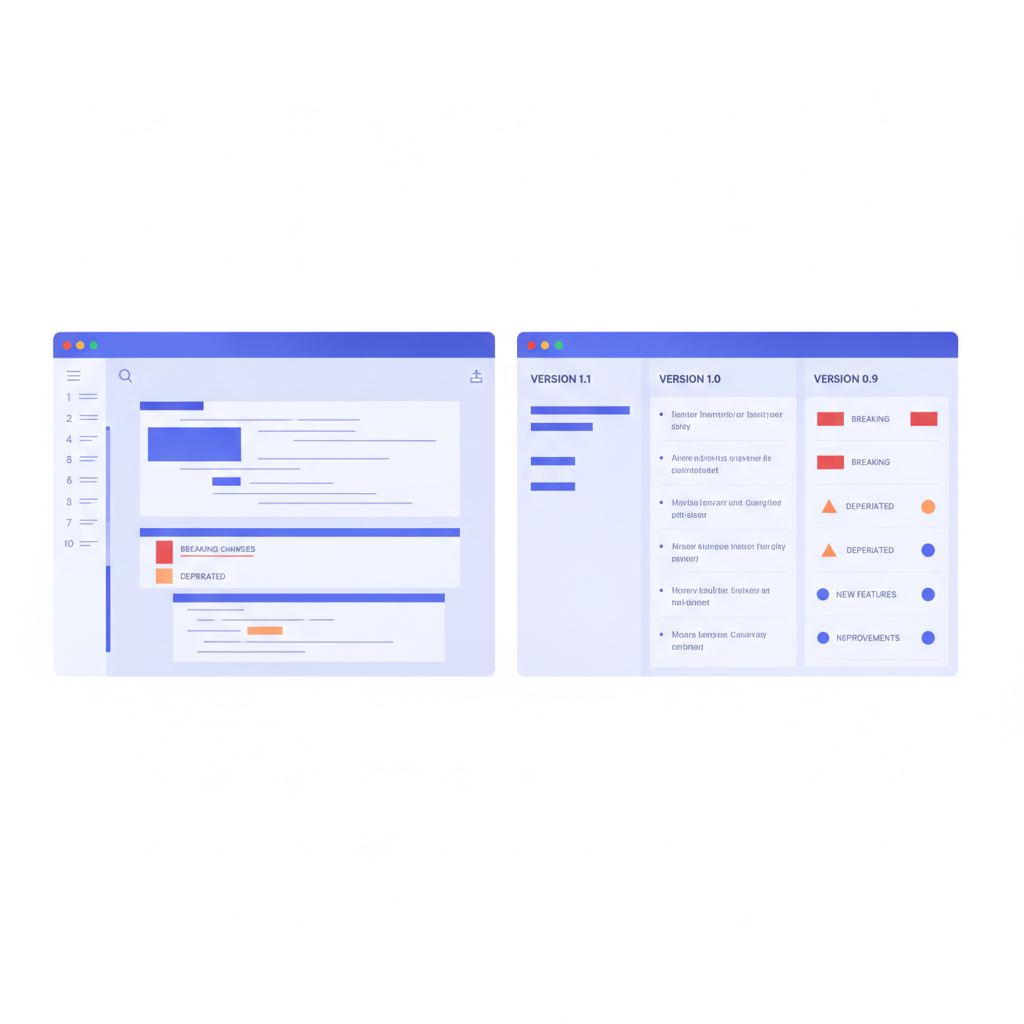
Breaking changes should always appear at the top of a release section, in their own block, before any ADDED or FIXED items. The structure that works in practice has four parts: the severity tag, the affected method and path, what changed, and what the developer should do about it.
Here is a copy-paste template:
## v3.0.0 - 2026-09-15

### BREAKING
- **REMOVED** `GET /v2/users/:id/preferences`
  Previously returned a flat object of user preference keys. This endpoint
  is removed. Use `GET /v3/users/:id/settings` instead, which returns the
  same data under the `settings` key. Update your clients before 2026-12-01.

### DEPRECATED
- `POST /v2/auth/token` will be removed in v4.0.0. Use `POST /v3/auth/tokens`.

### ADDED
- `GET /v3/users/:id/settings` (200 OK) returns user settings with pagination
  support via `?page` and `?per_page` query parameters.

### FIXED
- `POST /orders` now returns 201 Created instead of incorrectly returning 200 OK.
Notice the concrete specifics: the old path, the new path, a plain-English explanation, and a sunset date. Vague entries like "improved authentication" tell a consumer nothing actionable. According to RFC 9110, status code semantics are part of the HTTP contract, so a correction from 200 to 201 is a real, documentable fix worth listing.
Linking changelog entries to versioned reference docs
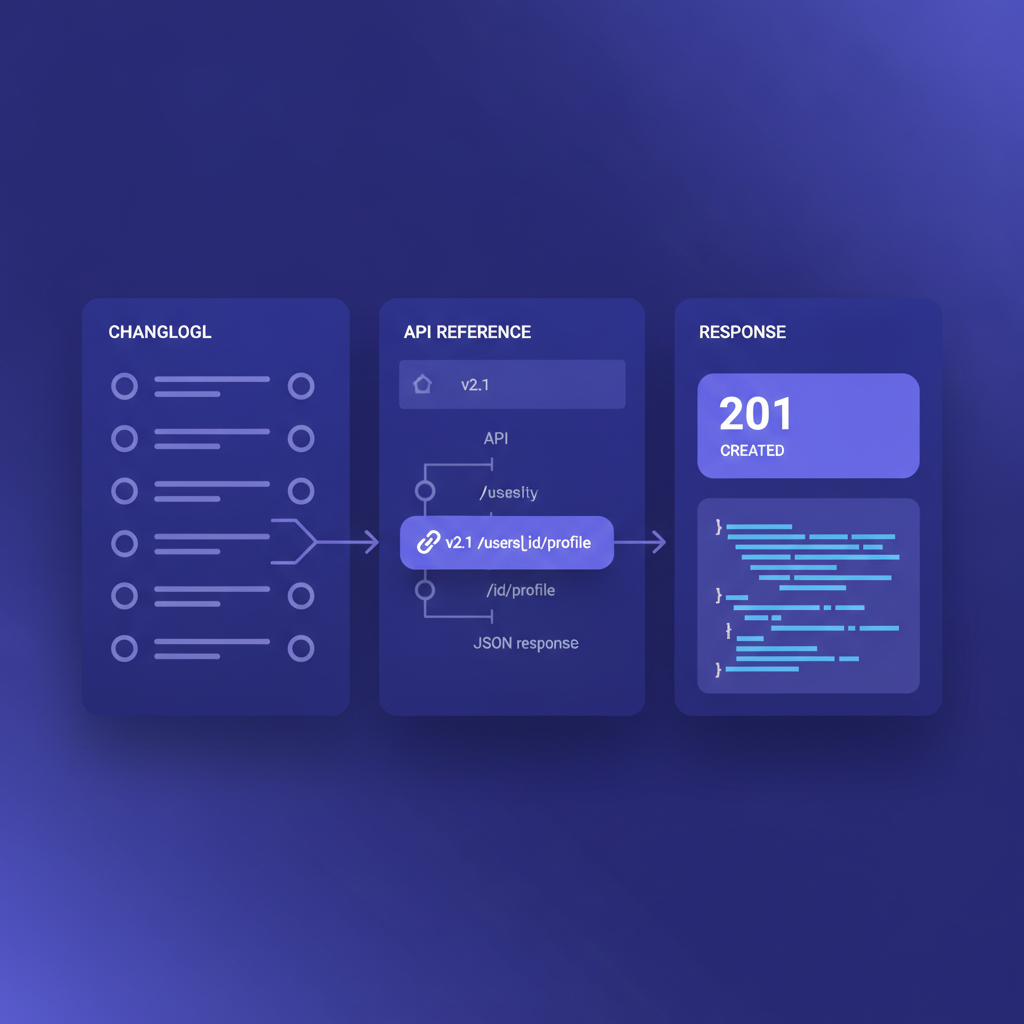
A changelog entry that names an endpoint without linking to its current definition forces the reader to go find the docs themselves. That friction compounds across hundreds of developers and dozens of releases. The practice is simple: every endpoint reference in the changelog should be a hyperlink to the specific versioned reference page for that resource.
In Apidoke, each project keeps a full version history. When you publish a new version of your API Blueprint doc, the previous versions remain accessible at their own URLs. That means you can link a changelog entry to the exact snapshot of the docs that matches the release, not just the current live docs. Consumers looking at the v2.4.0 changelog can reach the v2.4.0 reference doc, not the v3.0.0 one.
The workflow in Apidoke looks like this:
- Update your API Blueprint source in the CodeMirror editor and confirm the live preview reflects the change.
- Publish a new version snapshot from the project dashboard. Apidoke creates an immutable, publicly accessible URL for that version.
- Copy the versioned URL for the affected resource group.
- Paste the URL into your changelog entry, anchored to the endpoint path, for example: /v3/users/:id/settings reference.
- Publish the updated changelog (which can live as a Markdown section in its own Apidoke project or as a separate page in your developer portal).
For a deeper look at how versioning works across the full docs lifecycle, the API versioning strategies guide covers URL versioning, header versioning, and how to surface each approach in your reference docs.
What cadence should an API changelog follow?
Cadence is the question teams argue about most. The answer depends on your release model, but the principle is consistency over frequency. A changelog published on a chaotic schedule trains consumers to stop trusting it.
| Release model | Recommended cadence | Notes |
|---|---|---|
| Continuous deployment (multiple releases per day) | Daily digest or per-sprint rollup | Group small patch releases into a single dated section to avoid noise |
| Sprint-based (1 to 2 week sprints) | Per-sprint, on the release day | Align the changelog publish date with the sprint tag |
| Milestone releases (monthly or quarterly) | Per release, with a preview entry 2 weeks before launch | The preview entry lets consumers start planning migration before the GA date |
One pattern that works well in practice is the preview entry. Two weeks before a MAJOR release, add an entry tagged UPCOMING BREAKING that describes what will change, includes a migration path, and names a sunset date. This gives consumers time to act without being surprised on release day.
Structuring a changelog entry with API Blueprint syntax
If your API is documented in API Blueprint, the changelog can reference the exact Group and Resource names from your spec, so readers can find the right section in the rendered docs immediately. Here is how an entry maps to Blueprint structure.
Suppose your Blueprint has a Group named Orders with this resource:
# Group Orders

## Order Collection [/v3/orders]

### Create an Order [POST]

+ Request (application/json)

        {
          "product_id": "abc123",
          "quantity": 2
        }

+ Response 201 (application/json)

        {
          "order_id": "ord_9876",
          "status": "pending"
        }
A FIXED changelog entry for this resource might read:
### FIXED
- `POST /v3/orders` (Orders group) now returns 201 Created with an
  `order_id` field. Previously returned 200 OK with an empty body.
  See: [Order Collection reference](/docs/v3#orders-order-collection-post)
The anchor in the link points to the exact heading rendered by Apidoke from the Blueprint ### Create an Order [POST] action. This level of precision turns a changelog into a self-service tool rather than a source of confusion.
Deprecation notices: the right way to communicate sunset timelines
A deprecation is a promise. You are telling consumers that a feature will be removed on a specific date, and you are giving them time to migrate. That promise has three required components: the deprecated item (exact path and method), the replacement (exact path and method), and the removal date.
Deprecation headers in HTTP responses are an engineering-level signal covered in RFC 9110 and the draft Deprecation HTTP Header specification. The changelog is where you make the deprecation human-readable. Both should happen together.
A minimal deprecation entry:
### DEPRECATED
- `GET /v2/products` is deprecated as of 2026-09-15.
  Removal date: 2027-03-01.
  Replacement: `GET /v3/products` (see [Products reference](/docs/v3#products)).
  The v3 endpoint adds `category_id` filtering via the `?category` query param.
Repeat this entry verbatim in every subsequent changelog until the removal date. Consumers who only read the latest entry should still see the warning. When removal happens, replace the entry with a BREAKING entry in the removal release.
Where should the changelog live in your documentation?
The changelog should be reachable in one click from the top-level navigation of your API docs. Burying it in a GitHub repository or a Confluence page means only developers who already know to look will find it. That excludes non-developer stakeholders (product managers, partner engineers, QA teams) who also need to track changes.
In Apidoke, the cleanest approach is to maintain the changelog as its own API Blueprint project with a single Markdown-formatted document, published publicly alongside the reference docs. The versioned publishing and the clean three-column layout make the history scannable. You can link between the changelog project and the reference project using standard hyperlinks.
For teams thinking about the broader picture of how a changelog fits into the full developer experience, the developer experience guide for API teams covers how documentation, versioning, and communication cadence combine to reduce integration friction.
Common mistakes that make API changelogs useless
Even teams with good intentions make structural mistakes that drain the changelog of its usefulness. Knowing the failure modes helps avoid them.
- Omitting the version label. An undated, unlabeled entry cannot be correlated to a deployed version. Always include the semver tag and the ISO 8601 date (e.g.,
2026-09-15). - Describing the fix, not the change. "Fixed authentication bug" tells a consumer nothing. "
POST /auth/tokennow returns 401 Unauthorized instead of 500 Internal Server Error when credentials are invalid" tells them exactly what changed and whether they are affected. - Combining breaking and non-breaking items without separation. Readers scan for BREAKING first. If it is mixed into a flat list, they have to read everything to be safe, which they will not do.
- Not linking to the updated docs. A changelog without links to the reference is a dead end. Every path reference should be clickable.
- Publishing retroactively in batches. A changelog entry added three weeks after the release loses credibility. The standard is to publish the entry on or before the release date.
Frequently asked questions
What is the difference between an API changelog and API release notes?
A changelog is a precise, developer-facing record of every change to the API contract, organized by semver version and severity (BREAKING, DEPRECATED, ADDED, FIXED). Release notes are a higher-level, often marketing-facing summary of a release. Both can coexist, but for technical consumers, the changelog is the authoritative source.
How do you mark a breaking change in an API changelog?
Place a BREAKING tag at the top of the release section, before any other entries. Name the exact HTTP method and path that changed, describe the old behavior and the new behavior in concrete terms, and link to the updated reference doc. If there is a migration path, include it inline.
How often should an API changelog be updated?
The changelog should be updated with every release that touches the public API contract, at minimum. For continuous-deployment teams, a daily or per-sprint digest that groups small patch releases reduces noise while keeping the record current. The key principle is consistency: an irregular changelog is nearly as useless as no changelog at all.
Should deprecated endpoints appear in every changelog entry until removal?
Yes. Repeat the deprecation notice in every release section until the endpoint is removed. Developers who only read the most recent changelog entry should still see active deprecation warnings. When removal happens, replace the DEPRECATED entry with a BREAKING entry in the removal release.
How do I link a changelog entry to a specific version of my API docs?
Publish a version snapshot of your reference docs at the time of the release, then copy the URL for that versioned snapshot and embed it in the changelog entry. In Apidoke, each published version of a project gets its own persistent URL, so the v2.4.0 changelog can link to the v2.4.0 reference docs and those links will not break when v3.0.0 is published.
Ready to start publishing versioned API docs with a built-in changelog workflow? Create your free Apidoke account and publish your first versioned API Blueprint project in minutes, no credit card required.