
Building an API Documentation Team: Roles, Skills, and Workflow

An API docs team workflow is the set of roles, handoffs, and publishing steps that keeps your API reference accurate and your developer portal alive. In practice, most teams at Apidoke-using organisations start with one or two engineers writing Markdown-style API Blueprint files directly in the browser editor, then grow into a structured process as the API surface expands. The right structure depends on your team size, release cadence, and who owns the API contract.
- Dedicated technical writers are not always required to ship high-quality API docs; developer advocates and engineers can own early-stage documentation with the right tooling.
- Ownership must be explicit: if product, engineering, and DevRel each assume someone else updates the docs, no one does.
- Apidoke's browser-based editor removes the local-toolchain barrier so product managers and non-engineers can contribute without a Git setup.
- Per-project version history in Apidoke means the team always has a rollback point, which gives reviewers the confidence to merge fast.
Why API documentation ownership breaks down
The most common failure mode is diffuse ownership. An engineer writes the first draft during the sprint that ships the endpoint. A product manager edits the description. A DevRel lead formats the code samples. No one controls the canonical source. Six months later, the POST /orders endpoint returns a 422 Unprocessable Entity for a missing field that the docs still describe as a 400 Bad Request, and your support queue grows.
The fix is not always hiring a dedicated writer. It is agreeing on a single source of truth, a clear review gate, and one person who is accountable for the published state. Tooling that makes contribution cheap, like Apidoke's split-pane editor with live preview, shifts the bottleneck from access to judgment.
The core roles in an API documentation team
Technical writer (API-focused)
A technical writer who specialises in APIs understands HTTP semantics well enough to read a GET /users/{id} route, verify that a 404 Not Found response is documented alongside the happy-path 200 OK, and spot when a parameter description contradicts the actual schema. They do not need to write production code, but they do need to read it. Expect to spend two to four weeks onboarding a good API writer to your domain before they ship independently.
At larger companies, one technical writer can support two to three engineering squads if those squads produce structured notes (a one-page brief per endpoint: method, path, request body, response codes, authentication requirements) rather than expecting the writer to reverse-engineer behaviour from source.
Developer advocate
Developer advocates (also called DevRel engineers or developer evangelists) combine writing ability with hands-on coding. They write getting-started guides, integrate code samples in multiple languages, and test the developer experience end-to-end, which means they are also the first to notice when a documented flow returns a 401 Unauthorized because the token scope changed without a docs update.
For early-stage APIs or small teams, a developer advocate can own the entire documentation surface. The trade-off is bandwidth: advocates who spend time on community, conferences, and sample apps have less time for maintenance. This is where a shared workflow and tooling discipline matter most. The developer experience guide for API teams covers how documentation fits into a broader DX strategy.
Engineering contributors
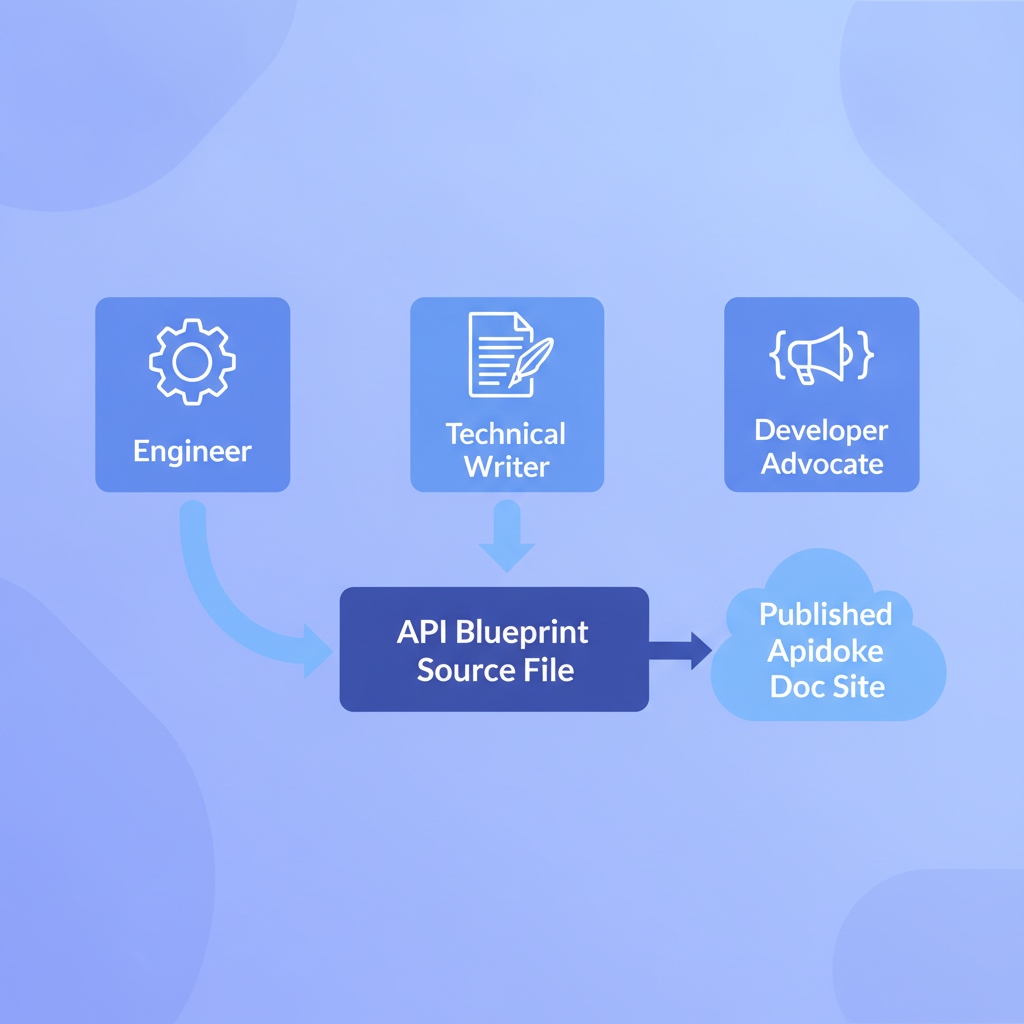
Engineers are the primary source of truth for what an API actually does. A well-run docs workflow treats engineers as contributors, not authors. Their job is to fill in a structured template at the point of development, not to produce publication-ready prose. In API Blueprint terms, this means adding the resource definition and at least one request/response pair:
## Orders [/orders]

### Create an Order [POST]

Creates a new order. Requires a valid bearer token with `orders:write` scope.

+ Request (application/json)

    + Headers

            Authorization: Bearer eyJhbGciOiJSUzI1NiJ9...

    + Body

            {
                "product_id": "prod_9k2m",
                "quantity": 2
            }

+ Response 201 (application/json)

    + Body

            {
                "order_id": "ord_7abc",
                "status": "pending",
                "created_at": "2026-01-15T09:41:00Z"
            }

+ Response 422 (application/json)

    + Body

            {
                "error": "validation_failed",
                "detail": "quantity must be a positive integer"
            }
The technical writer or advocate then reviews, enriches the prose, and publishes. Engineers do not have to be good writers; they need to be disciplined about the template.
Product manager as doc sponsor
Someone in product needs to own the prioritisation question: which endpoints get documented first, which audiences matter, and what counts as "done" for a release. Without a PM in this role, documentation work competes invisibly with feature work and loses every time. The PM does not write docs, but they sign off on the definition of the documentation done-criteria alongside the engineering done-criteria.
How to divide ownership between product and engineering
A clean split looks like this:
| Responsibility | Owner | Input they provide |
|---|---|---|
| API design decisions (naming, versioning, error codes) | Engineering lead | API contract, OpenAPI or Blueprint draft |
| Business context and audience framing | Product manager | Use-case brief, target persona notes |
| First draft of reference content | Engineer (per endpoint) | Blueprint snippet with request/response examples |
| Copy editing, consistency, code sample quality | Technical writer or DevRel | Reviewed and edited Blueprint file |
| Publishing and version management | DevRel or docs lead | Published Apidoke project, version tagged |
| Ongoing accuracy checks | All (rotating reviewer) | Pull request review or Apidoke editor comment |
The key insight is that accuracy lives closest to engineering, while clarity lives closest to the writer or advocate. Neither can fully substitute for the other.
What skills does an API documentation team actually need?
Technical literacy, not engineering depth
Writers do not need to ship production code. They do need to understand HTTP verbs (GET, POST, PUT, PATCH, DELETE), status code families (2xx success, 4xx client error, 5xx server error), authentication patterns (Bearer tokens, API keys, OAuth 2.0 scopes), and JSON structure. A writer who can read a curl command and predict what the response will look like is ready to document a REST API.
API Blueprint authoring
API Blueprint is a Markdown-based format for describing HTTP APIs. The full specification is maintained at apiblueprint.org. The core structures your team needs to learn are # Group (logical sections), ## Resource (a URL), ### Action (a method on that URL), and + Request / + Response blocks. The API Blueprint syntax cheat sheet covers these in copy-paste form.
Most writers with technical communication backgrounds learn enough Blueprint to be productive in a day or two. The format is intentionally readable, which is one reason teams choose it over more complex description languages.
Review discipline
The skill that is hardest to hire for and easiest to overlook is structured review: the ability to check a draft against a live API, verify every status code, confirm that authentication examples use plausible but non-production credentials, and catch ambiguous prose before it ships. The API documentation review checklist gives teams a concrete gate to use before publishing.
Building the workflow: from draft to published doc
- Design review includes a docs brief. When engineering signs off on an API change, the ticket includes a one-page doc brief: the endpoint path and method, expected request body, all possible response codes with at least one example body per code, and any authentication requirement.
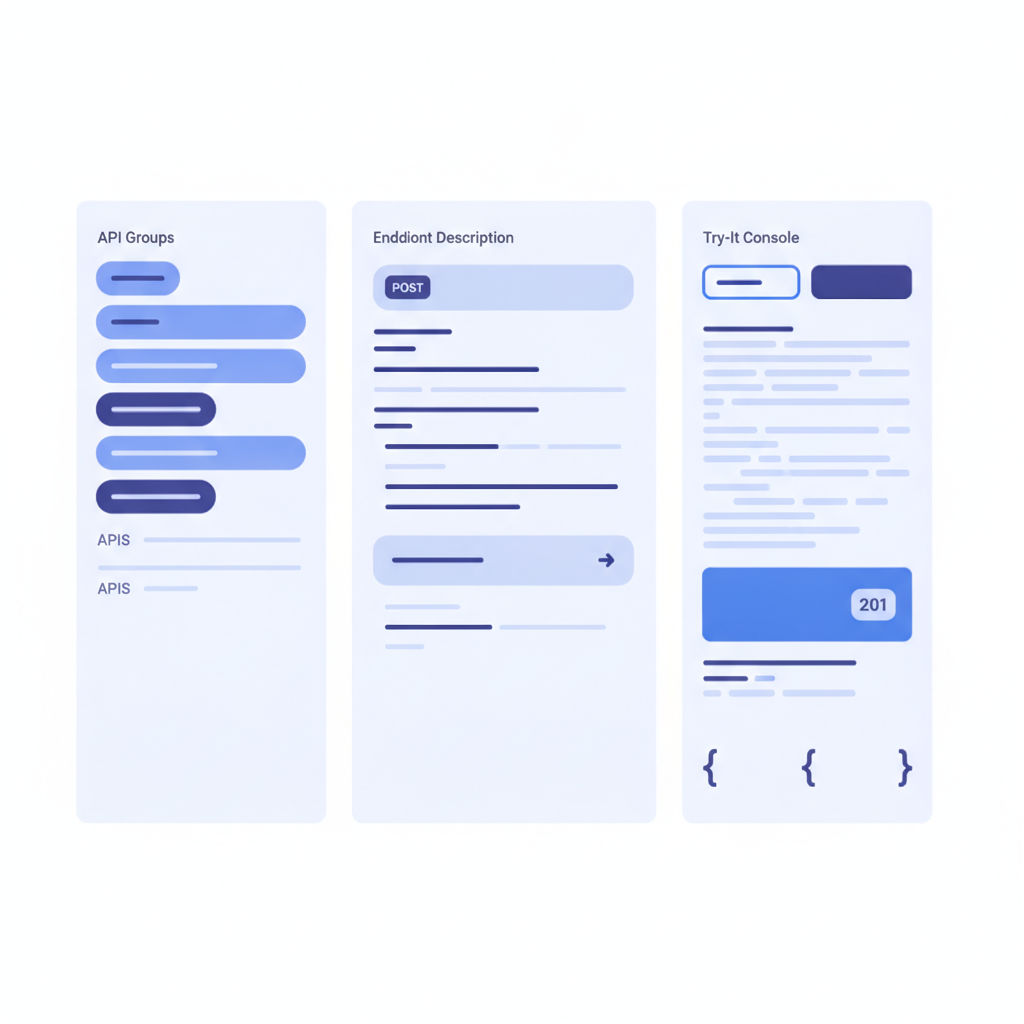
- Engineer opens the Apidoke editor and adds the Blueprint snippet. Because Apidoke runs in the browser with a live preview panel, the engineer sees the rendered three-column output immediately, including the navigation sidebar, the content panel, and the try-it console, before saving.
- Writer or advocate reviews the draft. They check prose clarity, verify that error responses are complete (a
404 Not Foundwith no example body is not a complete doc), and confirm that code samples are accurate. They edit directly in the same Apidoke project. - PM signs off on the business framing. A five-minute async review, not a meeting. The PM checks that the use-case context matches the product intent.
- The doc is published with a version tag. Apidoke's per-project version history records every saved state. If the next sprint changes the endpoint behaviour, the team can diff the current Blueprint against the previous version rather than reconstructing what changed.
- The try-it console is verified post-publish. Someone (usually the engineer or DevRel) fires a real request from the Apidoke try-it console against the staging or production endpoint. Auth tokens entered in the console stay in the browser and never reach Apidoke's servers, so this step is safe to run with real credentials against a sandboxed environment.
How team size changes the model
| Team size | Recommended structure | Who publishes? |
|---|---|---|
| 1 to 5 engineers, no dedicated writer | Rotating doc owner per sprint, DevRel if available | Lead engineer or DevRel |
| 5 to 20 engineers, 1 DevRel | DevRel owns structure and review; engineers draft per endpoint | DevRel |
| 20+ engineers, 1+ technical writers | Writers own reference docs; DevRel owns guides; engineering contributes drafts | Docs lead or dedicated publisher |
| Platform team with internal API consumers | Engineering squad owns docs alongside the API; writer does quarterly audits | Squad tech lead |
How Apidoke lowers the barrier for non-writer contributors
The single biggest friction point in a multi-role docs workflow is tool access. If contributing to docs requires cloning a repository, installing a static site generator, and running a local build, only engineers contribute. Product managers and DevRel leads with non-engineering backgrounds never touch the source.
Apidoke's editor runs entirely in the browser. There is no CLI, no Node.js installation, and no build step. A product manager can open the project, edit the description of an endpoint, see the rendered output in the live preview pane, and save, all without leaving their browser. Per-project version history means any accidental edit is reversible without a Git revert command.
For teams that do want to manage their Blueprint files in Git, Apidoke supports self-hosting, so the published output lives on infrastructure the team controls. Either way, the authoring experience stays accessible to the full documentation team, not just the engineers.
Common workflow mistakes and how to fix them
Documenting after the fact
Docs written two weeks after a release are always less accurate than docs written during development. The fix is treating the doc brief as part of the engineering ticket, not a post-sprint task. API-first design practices formalise this: the Blueprint or contract is written before the implementation, which also means the docs are a first-class artefact from day one. The post on API-first design and how documentation fits in covers this approach in depth.
Skipping error responses
Teams routinely document the 200 OK happy path and nothing else. In practice, developers integrating your API spend most of their debugging time on 400, 401, 403, 404, and 422 responses. Document at least one example body for every status code your endpoint can return. The IETF RFC 9110 defines the semantics of each HTTP status code class; linking to it in your style guide gives the whole team a shared reference.
No style agreement
When four people contribute to the same doc set, you get four naming conventions, four ways to describe authentication, and four formats for code samples. An API style guide solves this before it compounds. Even a one-page document covering parameter naming (snake_case or camelCase), how to present Bearer token examples (use a clearly fake token like eyJhbGciOiJSUzI1NiJ9.EXAMPLE), and which HTTP status codes get their own response block is enough to keep a small team consistent.
Measuring whether your docs workflow is working
You do not need analytics instrumentation to get a rough signal. Three leading indicators work without any tooling:
- Support ticket topics: If a recurring question maps directly to a documented endpoint, the doc is either wrong, incomplete, or unfindable. Triage your last 20 API-related support tickets and see how many point to a documentation gap.
- Time to first successful API call: Ask a developer who has never used your API to make a successful
POSTrequest using only your docs. Time how long it takes. Under 15 minutes is a reasonable target for a well-documented API with a working try-it console. - Review turnaround: How many days does a doc draft sit waiting for review before it publishes? More than three working days usually signals a missing owner or an unclear review process, not a writing quality problem.
Frequently asked questions
Do I need a dedicated technical writer to produce good API docs?
No. Small teams often start with a developer advocate or a disciplined engineer filling the writer role. A dedicated technical writer pays off when your API surface is large enough that accuracy checks and copy editing consume more time than engineering can spare, typically around 50 or more documented endpoints or 20 or more active external developers.
Should engineering or DevRel own the API documentation workflow?
Engineering owns accuracy (they know what the API actually does) and DevRel or technical writing owns clarity and consistency. The best workflows assign engineering the task of producing a structured draft per endpoint, then hand review and publishing to DevRel or a writer. If you have no DevRel function, a rotating engineer with doc ownership each sprint is a workable alternative.
How does Apidoke fit into a multi-person documentation workflow?
Apidoke's browser-based editor means any team member can contribute to the API Blueprint source without installing tools. Per-project version history gives the team a rollback point after every save, and one-click publishing means the reviewed doc reaches developers immediately. The try-it console fires real requests from the reader's browser, so DevRel can verify integrations without leaving the doc site.
What is the right way to handle doc updates when an API changes?
Tie doc updates to the same ticket or pull request as the API change. Before merging, the reviewer checks that all affected Blueprint blocks (request bodies, response codes, parameter descriptions) reflect the new behaviour. Apidoke's version history lets you tag the state of the docs at the point of each API release, making it straightforward to compare what changed between versions.
How do we stop docs from going stale between releases?
Schedule a quarterly accuracy audit where one person fires every documented endpoint from the try-it console and verifies the response matches the documented example. Flag any discrepancy as a bug, not a doc task, and assign it with the same urgency as a broken integration test. Treating stale docs as a product defect rather than a writing backlog item changes how quickly teams fix them.
Ready to give your whole team a documentation workflow that does not require a local toolchain? Create your free Apidoke account and publish your first API Blueprint project in the browser today, no credit card required.