
API Documentation Governance: Policies, Owners, and Audit Cycles

API documentation governance is the set of policies, ownership rules, and audit processes that keep API docs accurate, consistent, and trustworthy as a product grows. Without it, docs drift from the actual API: endpoints get deprecated without warning, request parameters go undocumented, and new engineers inherit a reference they cannot trust. Apidoke's built-in version history and structured authoring workflow give teams a concrete foundation on which to build a real governance programme.
- Governance means assigning a named owner to every API resource group, not just to the docs site as a whole.
- Audit cycles (quarterly for stable APIs, monthly for fast-moving ones) catch doc debt before it compounds into a support burden.
- A written policy that defines what counts as a doc violation is the difference between a standard and a suggestion.
- Self-hosted tooling like Apidoke keeps version history alongside the docs themselves, making audits a diff exercise rather than a guessing game.
What is API documentation governance?
Governance, in the context of API docs, borrows from software governance: it is the combination of written rules, accountable people, and scheduled review processes that prevent quality from decaying passively. The term is distinct from a style guide (which covers tone and formatting) and from a review checklist (which is a per-PR quality gate). Governance operates at the programme level: who owns which docs, how often they are audited, what happens when they fail, and how doc debt is prioritised and retired.
The closest analogy in software engineering is data governance, where organisations define data owners, data quality SLAs, and remediation workflows. The same logic applies to docs: an unowned resource degrades. According to the Linux Foundation's API specification working groups, documentation accuracy is consistently cited as the top friction point for third-party API consumers. That problem is structural, not just a writing quality issue, and it requires a structural answer.
Why growing API teams need governance specifically
At one or two developers, governance is implicit: the person who wrote the endpoint writes the docs. At ten engineers across three squads, implicit governance breaks down. Common failure modes include:
- A
POST /ordersendpoint gains a requiredidempotency_keyfield in a sprint, but the docs still show it as optional. Consumers start getting unexpected422 Unprocessable Entityresponses. - An authentication scheme migrates from HTTP Basic to Bearer tokens (as defined in RFC 9110), but the docs still show
Authorization: Basic, causing401 Unauthorizederrors for new integrators. - A deprecated
GET /v1/usersresource is still live in the published reference, generating support tickets six months after the endpoint was removed.
Each of these is an ownership failure. The fix is not better writing; it is a named person who knew the change was happening and had a policy obligation to update the docs before the release shipped.
The four pillars of an API doc governance programme
1. Ownership assignment
Every resource group in your API Blueprint source file should have a named owner in a governance register. In API Blueprint, resource groups map directly to the # Group keyword. A minimal governance register is a plain table maintained in your repository:
| Resource group | API Blueprint section | Doc owner | Backup owner | Last audited |
|---|---|---|---|---|
| Orders | # Group Orders | Sara Okonkwo | Dev Patel | 2025-03-15 |
| Authentication | # Group Authentication | Marcus Liu | Sara Okonkwo | 2025-04-01 |
| Webhooks | # Group Webhooks | Priya Sharma | Marcus Liu | 2025-02-20 |
Ownership should follow the same team that owns the service, not a dedicated docs team. When the Payments squad deprecates a field, the Payments squad's doc owner updates the docs. A centralised docs team reviewing changes downstream is a lagging indicator; embedded ownership is a leading one.
2. A written documentation policy
A policy turns an aspiration into an obligation. It should specify, at minimum:
- Coverage requirements: Every endpoint (action, in API Blueprint terms) must have a description, at least one
+ Requestexample with headers and a body where applicable, and at least one+ Responseexample for each documented status code. - Mandatory status codes: Success responses (200, 201, 204), client errors (400, 401, 403, 404, 422), and rate-limit responses (429) must be documented for every endpoint where they are possible.
- Deprecation notice lead time: Any resource or field marked deprecated must include a deprecation date and a migration path in the docs at least 30 days before removal.
- Definition of done: A feature is not releasable until its corresponding doc section passes the review checklist described in the API documentation review process guide.
Write this policy in plain language, version it alongside your API Blueprint files, and link to it from your contributing guide. A policy no one can find is not a policy.
3. Audit cycles
An audit cycle is a scheduled, structured pass over the entire published reference to verify that what the docs say matches what the API does. The frequency depends on change velocity:
| API change velocity | Recommended audit cadence | Typical audit duration |
|---|---|---|
| Stable (major release every 6+ months) | Quarterly | 1 to 2 days per owner |
| Active (monthly releases) | Monthly | Half a day per owner |
| Rapid (weekly or continuous deployment) | Post-release, every sprint | 1 to 2 hours per owner |
During an audit, each doc owner does three things:
- Fire every documented endpoint using the live try-it console in Apidoke and compare the real HTTP response (status code, headers, body) against what the docs claim. A
GET /invoices/{id}that returns404 Not Foundwith a JSON error body but whose docs show a plain-text response has a doc defect, not an API defect. - Diff the current API Blueprint source against the previous version in Apidoke's per-project version history. Any change to request parameters, response schemas, or authentication requirements that is not reflected in the prose is flagged as a doc debt item.
- Check that all deprecated endpoints or fields carry a visible deprecation notice and a removal date that is still in the future. If the date has passed and the endpoint still exists, the policy requires a timeline update.
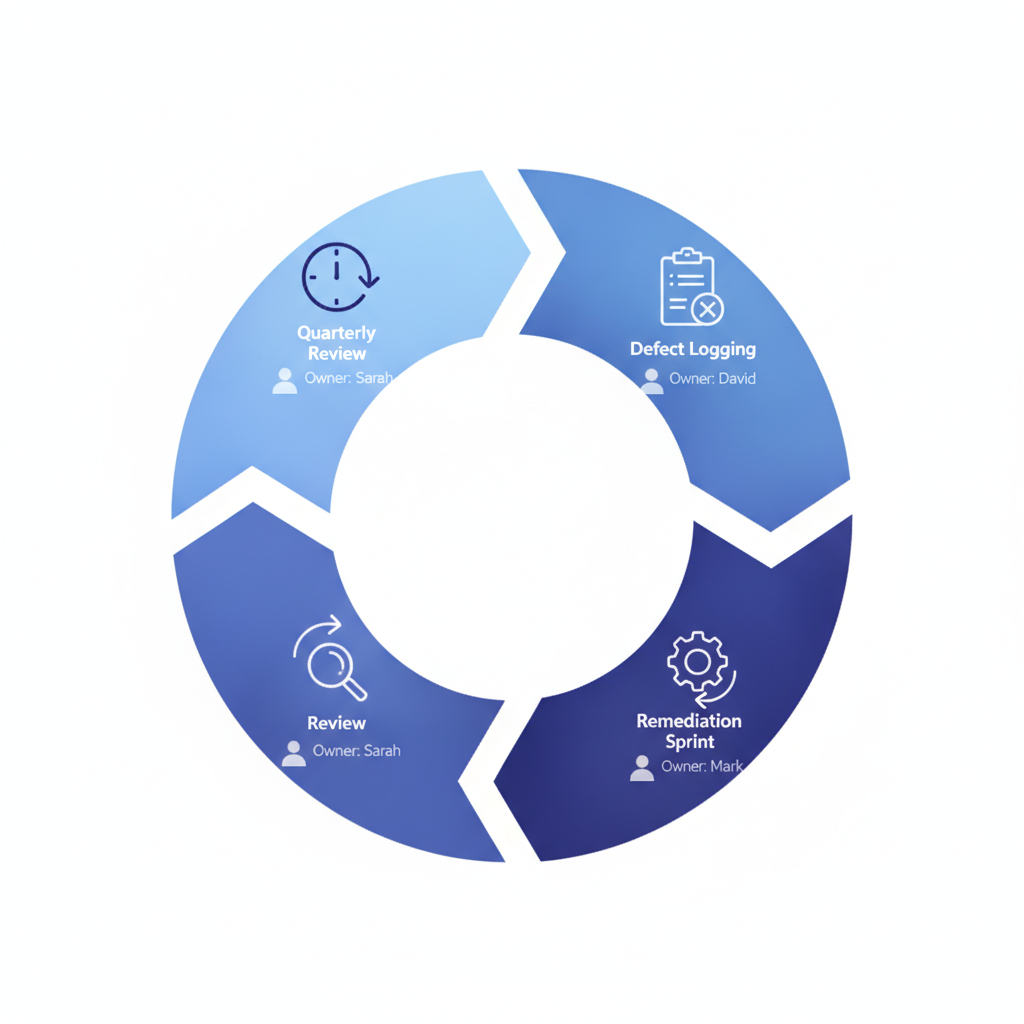
Document audit findings in a shared tracker (a GitHub issue labelled doc-debt works fine). Each finding should include the resource group, the defect type, the severity (P1 for broken examples, P2 for missing status codes, P3 for stale prose), and the assigned owner.
4. Doc debt management
Doc debt (the accumulated gap between what an API does and what the docs say) behaves like technical debt: it is rarely urgent on its own, but it compounds. A single undocumented parameter becomes three when a junior engineer follows the pattern for the next endpoint. Two stale examples become eight after a major authentication migration.
Treat doc debt with the same rigour you apply to technical debt. Practical approaches:
- Reserve 10 to 15 percent of each sprint for doc debt items surfaced in the governance register. This prevents audit findings from aging indefinitely.
- Assign severity levels and set SLAs: P1 defects (incorrect examples that cause integration failures) closed within 48 hours; P2 defects (missing status codes, incomplete request bodies) within the current sprint; P3 defects (prose inaccuracies, vague descriptions) within the quarter.
- Track the doc debt ratio: number of open doc debt issues divided by total documented endpoints. A ratio above 15 percent is a signal that the ownership model or the release process is not working.
Enforcing standards: where policies meet tooling
Governance checkpoints in the release process
The most reliable place to enforce doc governance is at the point where code changes are approved. Add a doc coverage check to your pull request template. Before any PR that touches an endpoint can be merged, the author must confirm that the corresponding # Group section in the API Blueprint file has been updated, a new version has been saved in Apidoke, and the doc owner has approved the diff.
This is lightweight by design. You do not need a separate CI pipeline step (though you can add one using API Blueprint validation tools). A checkbox in the PR template, combined with a named reviewer obligation, is enough to catch the majority of coverage gaps before they ship.
What a governed API Blueprint section looks like
Below is a governed example for a single resource. It satisfies the coverage requirements defined in the policy above: a description, a complete request with headers and body, and responses for 201, 400, 401, and 422.
# Group Orders

Resources for creating and managing customer orders.
All endpoints require Bearer token authentication (see Authentication group).

## Order Collection [/orders]

### Create an Order [POST]

Creates a new order. The `idempotency_key` field is required to prevent
duplicate submissions on network retry. Orders are processed asynchronously;
a 201 response confirms acceptance, not fulfilment.

+ Request (application/json)

    + Headers

            Authorization: Bearer eyJhbGciOiJSUzI1NiJ9...
            Idempotency-Key: a3f1c9d2-88b4-4e6a-b12f-000c29e4a17d

    + Body

            {
              "customer_id": "cust_98765",
              "items": [
                { "sku": "WIDGET-001", "quantity": 2 }
              ],
              "currency": "USD"
            }

+ Response 201 (application/json)

    + Body

            {
              "order_id": "ord_00112233",
              "status": "pending",
              "created_at": "2025-06-01T09:15:00Z"
            }

+ Response 400 (application/json)

    Returned when the request body is malformed or missing required fields.

    + Body

            {
              "error": "invalid_request",
              "message": "'currency' must be an ISO 4217 code."
            }

+ Response 401 (application/json)

    Returned when the Bearer token is absent, expired, or revoked.

    + Body

            {
              "error": "unauthorized",
              "message": "A valid Bearer token is required."
            }

+ Response 422 (application/json)

    Returned when the request is well-formed but semantically invalid,
    for example when the referenced customer_id does not exist.

    + Body

            {
              "error": "unprocessable_entity",
              "message": "customer_id 'cust_98765' not found."
            }
A section written to this standard passes the audit without further intervention. The owner can open Apidoke's try-it console, fire a real POST request, and verify the response body matches the 201 example in under two minutes.
How Apidoke supports governance workflows
Apidoke is not a governance tool in itself; it is authoring and publishing infrastructure that makes governance practical rather than theoretical. Three specific capabilities matter here.
Per-project version history means every save in the CodeMirror editor creates a named snapshot. During an audit, the owner can open any previous version, diff the API Blueprint source against the current one, and immediately see which request parameters or response codes changed between versions. This removes the guesswork from the diffing step of the audit cycle described above.
The live try-it console fires real HTTP requests from the browser directly to your API. Auth tokens never pass through Apidoke servers; they stay in the browser session. An auditor can verify a GET /invoices/{id} endpoint by entering a real invoice ID, attaching a Bearer token, and comparing the actual 200 OK response body against the documented example, all without leaving the doc viewer. This is the fastest way to catch doc-to-API drift during an audit.
One-click publishing means that when a doc owner completes a remediation, the updated reference is live immediately. There is no deploy pipeline to wait for, which removes the excuse of deferred updates.
For a broader perspective on building quality developer experiences around your API, the developer experience guide for API teams covers how documentation fits into the full DX picture alongside onboarding and discoverability.
Common governance anti-patterns
The rotating-owner problem
Assigning ownership by sprint rotation (whoever touches the endpoint in this sprint owns the docs) sounds fair but produces no accountability. When something goes wrong six months later, there is no named person to ask. Ownership should follow team structure, not sprint assignments. The Payments squad owns the Payments group permanently, rotating only when engineers move teams.
Governance by committee
Requiring every doc change to pass through a central docs council before publishing slows down delivery without improving quality. Reserve committee review for structural changes (adding a new resource group, changing the authentication scheme globally, retiring a major version). Individual endpoint updates should be owned and approved within the squad.
Auditing without a written policy
An audit that has no written standard to audit against produces subjective findings that owners can dismiss. The written policy is not bureaucracy; it is the reference point that makes audit findings defensible. Without it, a finding of "this response example looks incomplete" can be argued away. With it, "this response is missing the 422 status code required by section 3.2 of the doc policy" cannot.
Starting a governance programme from scratch
- Inventory your current API Blueprint source files. List every
# Groupsection and every## Resourceblock. This is your baseline coverage map. - Assign a provisional owner to each group today, even if the assignment is imperfect. An imperfect owner is better than no owner. You can refine assignments in the first audit.
- Write a one-page policy document covering coverage requirements, mandatory status codes, deprecation notice rules, and definition of done. Store it in the same repository as your API Blueprint files.
- Schedule the first audit for 30 days from today. Use the three-step audit procedure described above. Log every finding in a shared tracker with a severity label.
- Run a one-sprint remediation to close all P1 and P2 findings from the first audit. Track the doc debt ratio before and after.
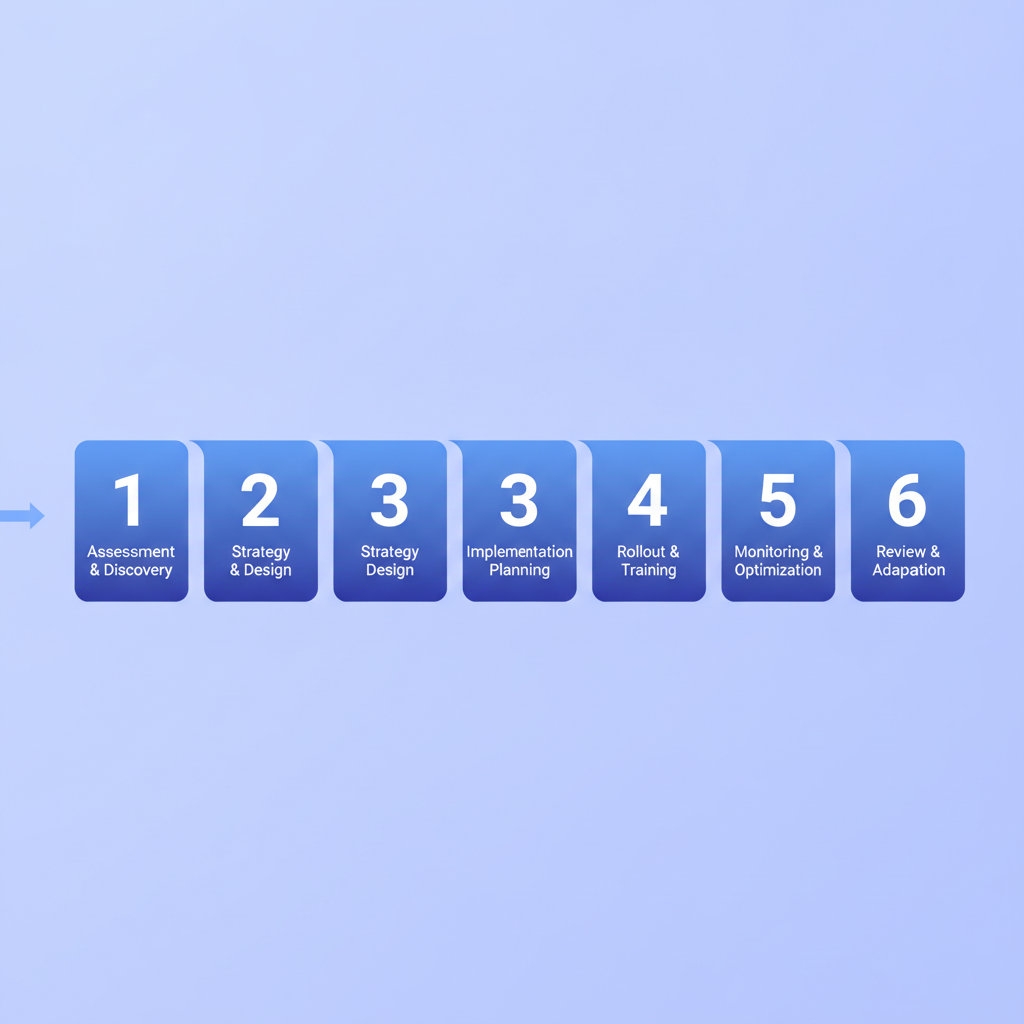
- Set the recurring audit cadence based on your change velocity, using the table above as a guide. Put it in the team calendar as a recurring event, not as a one-off.
Governance and the API style guide relationship
Governance is sometimes conflated with a style guide, but they operate at different levels. The API style guide defines how to write: verb tense, heading format, parameter naming conventions, how to describe nullable fields. Governance defines the system that ensures the style guide is actually followed: who checks for compliance, how often, and what happens when a section fails. You need both. A style guide without governance is aspirational. Governance without a style guide lacks a quality standard to enforce.
Frequently asked questions
Who should own API documentation governance in a growing team?
Ownership typically sits with a platform engineering lead or a developer experience lead who has authority across squads. That person sets the policy and runs the audit programme, but day-to-day doc ownership belongs to the engineers closest to each service. Centralising governance oversight while distributing doc ownership is the balance most teams find sustainable.
How is a doc audit different from a documentation review?
A documentation review is a per-change quality gate: it happens when a PR is raised and checks that a specific new or changed endpoint is documented correctly. A doc audit is a scheduled, comprehensive pass over all docs to verify ongoing accuracy. Reviews prevent new doc debt; audits surface accumulated doc debt.
What is doc debt and how do you measure it?
Doc debt is the gap between what the API does and what the docs say. You measure it by counting open doc defect issues divided by total documented endpoints. A ratio above 15 percent typically signals a process problem worth investigating.
Can Apidoke's version history support audit workflows?
Yes. Every time you save in Apidoke's editor, a named snapshot is created in the project's version history. During an audit, you can open any previous version alongside the current one, compare the API Blueprint source, and identify undocumented changes without relying on external version control diffs.
How often should we run API doc audits?
Quarterly for stable APIs with major releases every six months or longer; monthly for APIs with regular monthly releases; and after every sprint or deployment for fast-moving APIs. The key is that the cadence is scheduled and non-negotiable, not triggered only when something breaks.
Ready to give your team a documentation foundation that makes governance practical? Create a free Apidoke account and start with version history, a live try-it console, and structured API Blueprint authoring from day one, no credit card required.
Related reading: How to Conduct an API Documentation Audit