
OpenAPI vs Swagger: What Is the Difference?

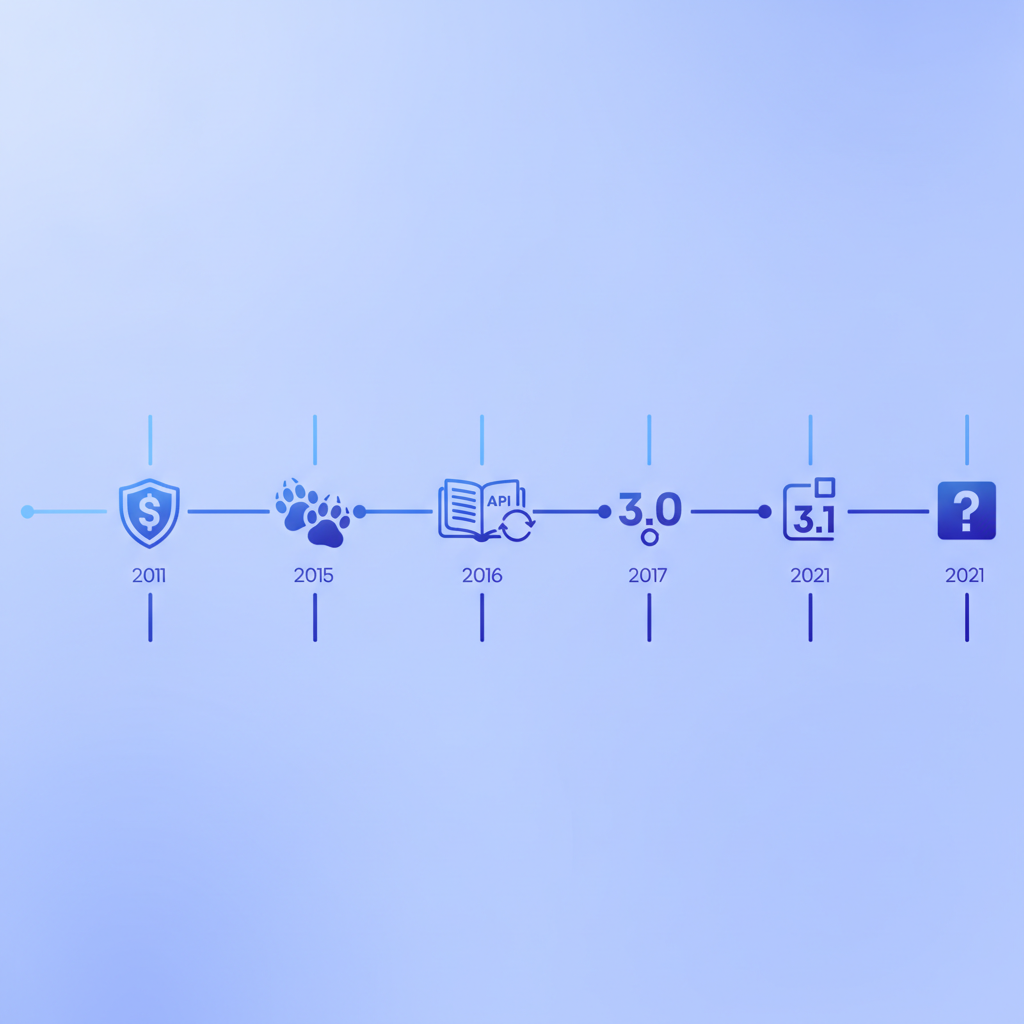
OpenAPI and Swagger refer to the same specification format, but they are not interchangeable terms. Swagger was the original name for the specification created by Wordnik around 2011. In 2016, SmartBear (which had acquired Swagger) donated the specification to the Linux Foundation, and it was renamed the OpenAPI Specification. Today, "OpenAPI" is the correct name for the standard; "Swagger" now refers specifically to SmartBear's tooling built around that standard. Apidoke, for its part, uses a different format entirely: API Blueprint, a Markdown-based specification designed for readable, human-friendly documentation.
- Swagger was renamed OpenAPI in 2016 when SmartBear donated the spec to the Linux Foundation's OpenAPI Initiative.
- "OpenAPI" now means the specification; "Swagger" now means the tools (Swagger Editor, Swagger UI, Swagger Codegen) maintained by SmartBear.
- The confusion is historical: both terms describe the same YAML/JSON format, but using "Swagger" to mean the spec is technically outdated.
- Apidoke does not use OpenAPI or Swagger; it uses API Blueprint, a distinct Markdown-native format with its own authoring and publishing workflow.
A brief history: how Swagger became OpenAPI
Swagger started as an internal project at Wordnik, a dictionary API company, around 2011. The goal was practical: give developers a machine-readable way to describe REST API endpoints so that documentation and client code could be generated automatically. The format used JSON (and later YAML) to define paths, HTTP methods (GET, POST, PUT, DELETE, PATCH), request parameters, and response schemas.
SmartBear acquired the Swagger brand in 2015. A year later, in January 2016, SmartBear and a group of industry partners including Google, IBM, Microsoft, and PayPal formed the OpenAPI Initiative under the Linux Foundation. The specification was donated to that body and immediately renamed the OpenAPI Specification (OAS). The version at the time of the transition was Swagger 2.0; the first version released under the new name was OpenAPI 3.0, published in 2017.
SmartBear retained the Swagger brand for its commercial and open-source tooling. So after 2016, if someone says "Swagger," they could mean one of three things: the old pre-2016 specification, SmartBear's tools, or (incorrectly but extremely commonly) the OpenAPI Specification itself.
What exactly is the OpenAPI Specification?
The OpenAPI Specification (currently at version 3.1, released in 2021) is a language-agnostic, machine-readable description format for HTTP APIs. A valid OpenAPI document is a YAML or JSON file that describes:
- API endpoints (called "paths") and the HTTP methods they accept
- Request parameters, headers, and body schemas
- Response codes (200 OK, 201 Created, 400 Bad Request, 401 Unauthorized, 404 Not Found, 500 Internal Server Error) and their body schemas
- Authentication schemes (API keys, OAuth 2.0, HTTP Bearer tokens)
- Reusable components via the
$refkeyword
A minimal OpenAPI 3.0 path definition looks like this:
openapi: "3.0.3"
info:
  title: Example API
  version: "1.0"
paths:
  /users/{id}:
    get:
      summary: Get a user by ID
      parameters:
        - name: id
          in: path
          required: true
          schema:
            type: integer
      responses:
        "200":
          description: A user object
        "404":
          description: User not found
The full OpenAPI Specification is maintained by the OpenAPI Initiative and is freely available.
What is Swagger today?
After the rename, SmartBear kept the Swagger brand for four main products:
| Tool | What it does | Open source? |
|---|---|---|
| Swagger Editor | Browser-based editor for writing OpenAPI documents | Yes |
| Swagger UI | Renders an OpenAPI file as interactive HTML documentation | Yes |
| Swagger Codegen | Generates server stubs and client SDKs from an OpenAPI file | Yes (forked as OpenAPI Generator) |
| SwaggerHub | Hosted, collaborative platform for OpenAPI design and publishing | No (commercial SaaS) |
So when a job posting asks for "Swagger experience" in 2025, it almost certainly means experience with OpenAPI-format files, probably rendered or tested using Swagger UI or SwaggerHub. The distinction matters in conversation, but in practice the toolchain is what people are actually referencing.
Why does the confusion persist?
Several reasons keep the old terminology alive:
- Swagger 2.0 is still everywhere. Countless APIs were documented using Swagger 2.0 before OpenAPI 3.0 shipped. Those files, tutorials, and Stack Overflow answers still circulate, and they all say "swagger" at the top of the YAML.
- The tooling kept the name. Because Swagger UI and Swagger Editor are still called Swagger, developers who use those tools naturally say "Swagger" when they mean the whole ecosystem.
- Search habits are slow to change. "Swagger docs" gets searched far more than "OpenAPI docs" even now, so content creators and vendors preserve the old terminology for discoverability.
- The format did not change dramatically. OpenAPI 3.0 introduced meaningful improvements (better support for callbacks, links, and the
anyOf/oneOfschema keywords), but it was a recognizable evolution of Swagger 2.0, not a rewrite. That continuity made renaming feel optional to many teams.
OpenAPI 3.0 vs Swagger 2.0: what actually changed?
If you are migrating an old Swagger 2.0 file to OpenAPI 3.0, or inheriting a legacy codebase, the structural differences are real. The most important ones:
| Feature | Swagger 2.0 | OpenAPI 3.0 / 3.1 |
|---|---|---|
| Top-level key | swagger: "2.0" | openapi: "3.0.x" |
| Request body | in: body parameter | Dedicated requestBody object |
| Reusable components | definitions, parameters | Unified components section |
| Multiple servers | Single host + basePath | servers array (multiple environments) |
| Content types | Top-level consumes/produces | Per-operation content map with media types |
| JSON Schema alignment | Partial (subset of draft 4) | Full alignment in 3.1 (draft 2020-12) |
OpenAPI 3.1 went further, fully aligning with JSON Schema draft 2020-12, which resolves long-standing edge cases around nullable fields and schema composition.
How does API Blueprint fit into this picture?
OpenAPI and API Blueprint are two separate, competing specification formats. They solve similar problems but take different approaches. OpenAPI is YAML/JSON-first and highly structured, optimised for machine tooling like code generation. API Blueprint is Markdown-first and human-readable by design, optimised for writing docs that developers actually enjoy reading and maintaining.
The two formats are not interchangeable, and Apidoke does not import or export OpenAPI/Swagger files. Apidoke is built specifically around API Blueprint: you write your spec in Markdown using the API Blueprint syntax, and Apidoke renders it into a live, three-column reference with a try-it console. If you want to understand how API Blueprint compares to OpenAPI and Swagger across all three formats in detail, the API Blueprint and Formats hub covers the full landscape.
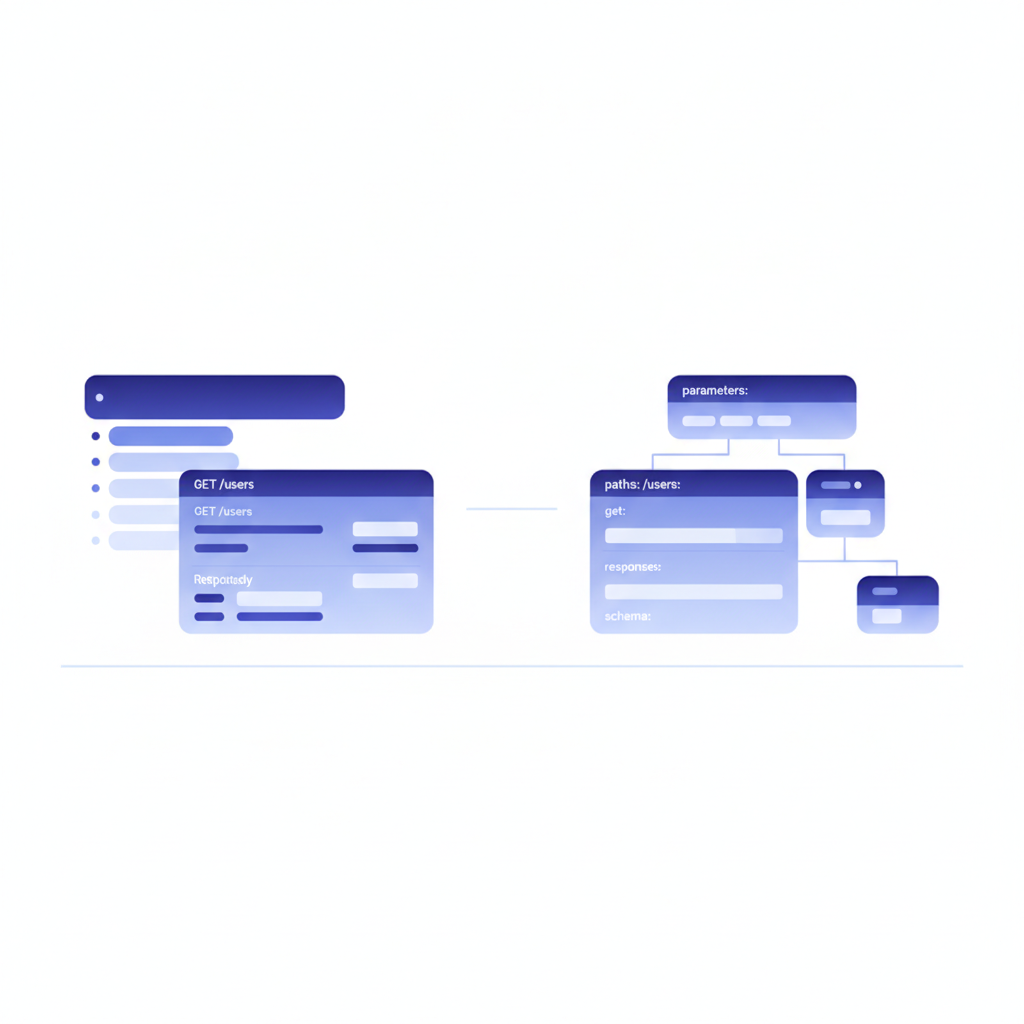
A quick example shows the philosophical difference. Here is how you would describe a GET /users endpoint that returns a 200 with a JSON array in API Blueprint:
# Group Users

## Users Collection [/users]

### List Users [GET]

+ Response 200 (application/json)

        [
          { "id": 1, "name": "Alice" },
          { "id": 2, "name": "Bob" }
        ]
The same endpoint in OpenAPI 3.0 YAML:
paths:
  /users:
    get:
      summary: List Users
      responses:
        "200":
          description: A list of users
          content:
            application/json:
              schema:
                type: array
                items:
                  properties:
                    id:
                      type: integer
                    name:
                      type: string
Neither is wrong. The API Blueprint version is easier to write by hand and reads like prose. The OpenAPI version is more amenable to schema validation, code generation, and tooling that inspects the schema deeply. Which you choose depends on what you need your spec to do.
Which term should you use?
In technical writing and conversation, use "OpenAPI" when referring to the specification format or standard. Use "Swagger" when referring to SmartBear's specific tools (Swagger UI, Swagger Editor, SwaggerHub). If you are reading an old tutorial or a legacy codebase that says "Swagger spec," it means the same format as OpenAPI, almost certainly Swagger 2.0.
For new projects, always target OpenAPI 3.1 rather than Swagger 2.0 or OpenAPI 3.0. The 3.1 release resolves the most common schema edge cases and has the broadest tool support going forward.
Frequently asked questions
Is Swagger the same as OpenAPI?
They describe the same format, but technically they are different things. Swagger was the original name for the specification; in 2016 it was renamed OpenAPI. Today, OpenAPI is the standard, and Swagger refers to SmartBear's tools built around that standard.
Is Swagger 2.0 still valid to use?
It still works and is supported by many tools, but it is outdated. OpenAPI 3.1 is the current version and offers better schema support, multiple server definitions, and full JSON Schema alignment. New projects should use OpenAPI 3.1.
What is the difference between Swagger UI and SwaggerHub?
Swagger UI is a free, open-source library that renders an OpenAPI file as interactive HTML documentation. SwaggerHub is SmartBear's paid, hosted platform for designing, hosting, and collaborating on OpenAPI documents, built on top of Swagger UI.
Does Apidoke support OpenAPI or Swagger files?
No. Apidoke is built around API Blueprint, a separate Markdown-based specification format. It does not import or parse OpenAPI or Swagger YAML files. If your team already writes API Blueprint, Apidoke renders it directly into a three-column doc site with a live try-it console.
What is the easiest way to start documenting a REST API if I want to avoid OpenAPI complexity?
API Blueprint is a popular choice for teams who find OpenAPI YAML verbose or hard to read. You write plain Markdown with lightweight syntax conventions, and a tool like Apidoke publishes it as interactive documentation without any build pipeline. See the getting-started guide for a step-by-step walkthrough.
If you want to write clean API docs in API Blueprint without configuring a toolchain, create a free Apidoke account and publish your first interactive API reference in minutes.
Related reading: Apidoke vs Scalar: Open-Source API Docs Compared
Related reading: Free and Open-Source API Documentation Tools in 2026