
How to Pitch Better API Documentation to Your Engineering Team

The fastest way to improve API documentation is to stop treating it as a writing problem and start treating it as a cost problem. Documentation debt is measurable: every 404 on a missing endpoint page, every support ticket asking how to authenticate, and every new hire who spends three days reverse-engineering a POST /orders endpoint carries a real dollar cost. Apidoke exists to lower that cost, but before you can choose a tool, you need internal agreement that the problem is worth solving.
- Doc debt compounds: unclear error codes, missing request examples, and stale responses slow down every consumer of your API, internal or external.
- Engineering managers respond to time and risk arguments, not aesthetics; frame the pitch around those two axes.
- You can quantify documentation quality today using four concrete signals, no special tooling required.
- Apidoke is free, self-hostable, and needs no credit card; removing cost objections up front shortens the approval path considerably.
Why good intentions never become better docs
The pattern is depressingly familiar. A developer files a ticket: "Docs for GET /users/{id} don't mention the 401 when the token is scoped wrong." The ticket gets acknowledged. It sits in the backlog behind three features. Six months later a new integration partner hits that exact 401 and opens a support ticket. That support ticket gets escalated. Someone fixes it in a Friday afternoon PR. Nobody updates the docs.
The root cause is not laziness. It is the absence of a shared agreement that documentation is a deliverable, not a finishing touch. Without that agreement, no tool and no process will hold. Your pitch needs to create that agreement before it proposes any solution.
How do you quantify API documentation debt?
Documentation debt (the accumulated cost of missing, stale, or unclear API docs) is harder to see than code debt, but it leaves traces in places engineering managers already watch.
Four signals you can pull this week
- Support ticket tagging. Go through the last 90 days of support or Slack threads. Tag every thread that included a question answerable by reading the docs. Count them. Even a rough count of 20 tickets at 30 minutes each is 10 engineering hours burned answering questions the docs should have handled.
- Onboarding time delta. Ask two or three engineers how long it took them to make a first successful authenticated request to your API when they joined. Compare that to how long it should take given a well-structured reference. A 3-hour gap across 5 new hires per year is 15 hours of senior-engineer time gone.
- HTTP error rate patterns. Pull server logs and filter for 4xx responses, particularly 400 (bad request) and 422 (unprocessable entity). A spike on a specific endpoint often means the request body is not documented clearly enough for consumers to construct it correctly.
- Stale endpoint count. Compare your current route list (from your router or an export) against what your docs actually cover. Every undocumented route is a debt item. Every documented route that references a removed or renamed parameter is a liability.
Pull these four numbers into a single slide. You now have a doc-debt estimate expressed in hours and risk, not in "the docs could be better."
What framing do engineering managers actually respond to?
Engineering managers think in sprints, risk, and headcount. The pitch that lands is the one that maps documentation improvement to those three things.
Frame it as risk reduction, not quality improvement
"Our docs are outdated" sounds like a cosmetic complaint. "Our docs caused three partner escalations last quarter and will cause more as we onboard the next cohort" is a risk statement. The distinction matters because risk reduction justifies immediate prioritization; quality improvement can always wait one more sprint.
Specifically, undocumented authentication behavior is a common escalation driver. If your docs do not show exactly what header carries the token, what scope is required, and what a 401 Unauthorized response body looks like, every new integration will hit that wall. A minimal but correct example of what that documentation should contain looks like this:
## Retrieve a User [GET /users/{id}]

Returns a single user record. Requires a Bearer token with the `read:users` scope.

+ Parameters
    + id: `u_8f3kx` (string, required) - The unique user identifier.

+ Request (application/json)
    + Headers

            Authorization: Bearer eyJhbGciOiJSUzI1NiJ9...

+ Response 200 (application/json)
    + Body

            {
              "id": "u_8f3kx",
              "email": "dana@example.com",
              "created_at": "2025-11-01T09:00:00Z"
            }

+ Response 401 (application/json)
    + Body

            {
              "error": "invalid_token",
              "message": "Token missing required scope: read:users"
            }

+ Response 404 (application/json)
    + Body

            {
              "error": "not_found",
              "message": "No user found with id u_8f3kx"
            }
That is API Blueprint format, the plain-text description language Apidoke uses. The point here is not the syntax; it is that a consumer seeing that documentation cannot produce the wrong request. Showing a manager the current state of your docs versus this example is more persuasive than any spreadsheet.
Frame it as a force-multiplier, not extra work
The instinctive managerial objection is: "We don't have bandwidth to write docs on top of shipping features." The counter-argument is that good docs reduce the total work in the system. When a partner can answer their own authentication question at 11 PM without filing a ticket, that is time your team never spends. When a new hire can make their first successful POST /payments call by following a reference that includes a real request body and a real 200 response, onboarding shrinks. The upfront cost of writing the docs is a one-time investment; the support and onboarding costs it prevents are recurring.
Frame the tooling cost accurately
One reliable objection killer is removing the cost variable entirely. Apidoke is self-hostable and requires no credit card. You can run a live, interactive API reference with a built-in try-it console, per-project version history, and a CodeMirror-powered editor with live preview, at zero licensing cost. The only cost is the time to write the docs, which you have already argued pays for itself. See the developer experience guide for API teams for a broader treatment of how tooling choices affect the full DX investment.
How to structure the actual pitch document
Keep the pitch to one page or one slide deck of five slides. Engineering managers skim; density signals you have done the work.
| Section | What it contains | Why it matters to a manager |
|---|---|---|
| Current state | Support ticket count, stale endpoint count, last doc update date | Establishes that the problem is real and already costing time |
| Cost estimate | Hours lost to avoidable support tickets and onboarding friction | Translates doc debt into engineering time, the unit managers budget in |
| Proposed change | Specific scope: which endpoints, which audiences, what format | Shows the work is bounded, not a sprawling indefinite project |
| Tooling plan | How you will author, review, publish, and keep docs current | Demonstrates you have thought past the first draft; this is a process, not a one-off |
| Success metrics | How you will know it worked: ticket reduction, onboarding time, coverage percentage | Makes the investment reviewable; good managers want to close the loop |
Addressing the "docs go stale" objection
This is the most intellectually honest objection a manager will raise, and you should have an answer ready. Docs do go stale. The solution is not perfection; it is a workflow that makes updating docs the path of least resistance.
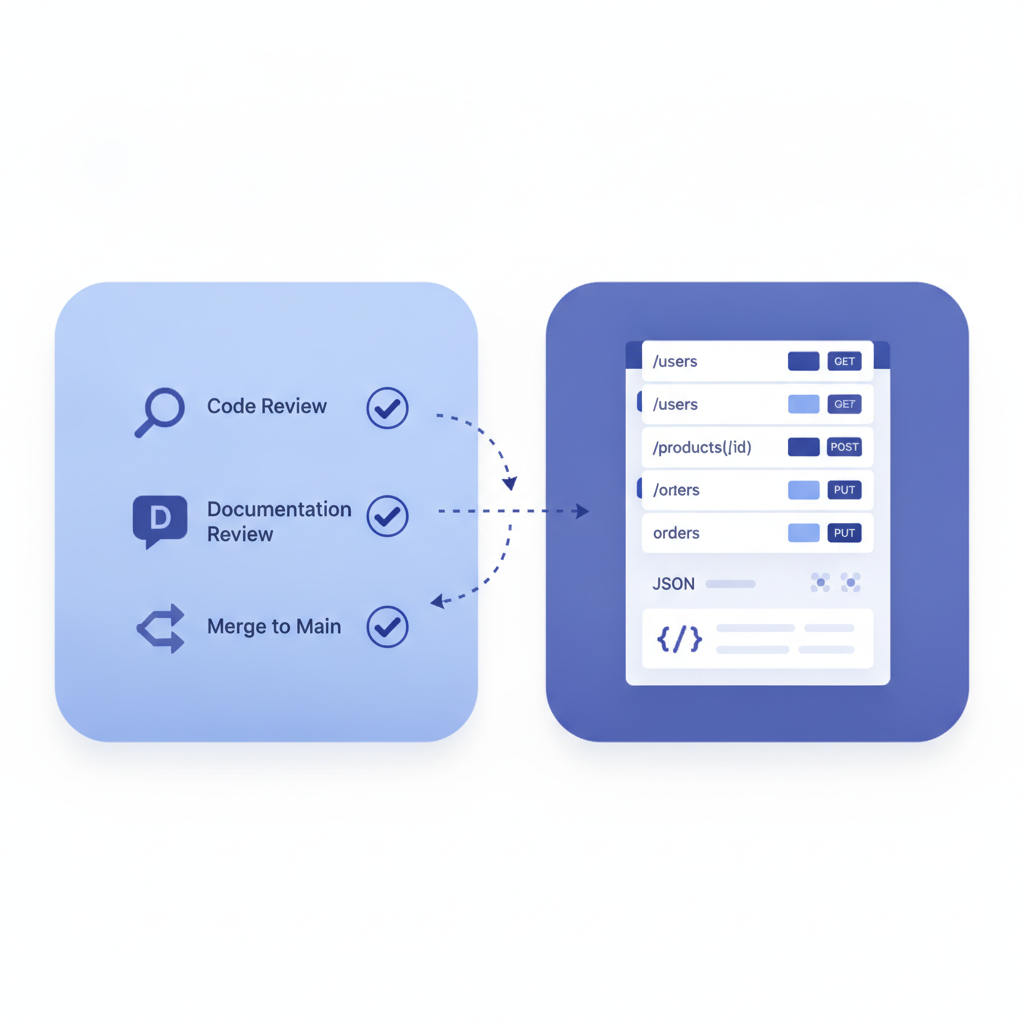
Two concrete answers exist. First, write docs in the same repository as the code, or at minimum in a tool that has version history so you can trace when a page last changed and compare it to the code commit that changed the corresponding endpoint. Apidoke maintains per-project version history, so you can see exactly what the docs said for version 1.4 versus what they say now. Second, add a documentation check to your PR template. One line asking "did this change affect any documented endpoints?" catches the majority of staleness before it ships. For a deeper treatment of keeping docs in sync with code changes, the post on continuous documentation and CI/CD integration covers this in detail.
Scoping the first improvement to avoid scope creep
A common mistake in these pitches is proposing to fix all the documentation at once. That triggers the bandwidth objection immediately. Instead, propose a scoped first iteration:
- Pick the three to five endpoints that generate the most support questions or the most onboarding friction. This is your doc debt from the signals you already pulled.
- Write or rewrite those endpoints to include: the HTTP method, the full URL with any path parameters defined, all required and optional query parameters, a realistic request body where relevant, and response bodies for at least 200, 400, and 401 status codes.
- Publish those five endpoints as a live reference using Apidoke. Include the try-it console so readers can fire a real request against your staging environment directly from the docs.
- Measure the ticket and question rate for those five endpoints over the next four weeks.
- Use the measurement to make the case for the next batch.
This incremental approach is far easier to approve than "rewrite all our docs" and far more likely to generate the evidence you need to expand the project.
What does a realistic improvement timeline look like?
For a typical REST API with 20 to 40 endpoints, a single engineer writing in API Blueprint format using Apidoke's editor can cover the highest-priority endpoints in a few focused sessions. The format is plain text, so there is no toolchain to configure and no build pipeline to set up before you can see a rendered preview. The first published reference can be live the same day you start, which matters when you are trying to show quick wins to build momentum.
The API Blueprint specification is maintained openly and describes a straightforward Markdown-derived syntax designed specifically for REST API description. Each endpoint description follows a predictable structure: a resource heading, an action heading, request and response bodies. A person who has never seen the format can read an existing file and understand it within minutes, which matters for code review and for onboarding reviewers who are not the original author. You can read the full specification at the official API Blueprint specification.

Handling the "we should use OpenAPI instead" detour
Someone in the room will ask this. The honest answer is that OpenAPI and API Blueprint solve the same core problem from different angles. OpenAPI is a JSON or YAML schema; API Blueprint is a Markdown prose-first format. Both describe REST APIs. The choice should depend on your team's existing workflow, not on a format holy war. If your team lives in Markdown and values readability over toolchain integration, API Blueprint is a lower-friction starting point. If you already have an OpenAPI file generated from your code annotations, that is a different conversation.
The important point for the pitch is that the format choice is secondary to the decision to write docs at all. Pick the format your team will actually maintain. The tool question follows from that.
Frequently asked questions
How do I convince my manager that API documentation is worth engineering time?
Lead with cost, not quality. Pull the number of support tickets in the last 90 days that asked questions the docs should have answered, multiply by the time each took to resolve, and present that as engineering hours lost. Managers respond to time and risk arguments far more readily than arguments about documentation quality in the abstract.
What is API documentation debt and how do I measure it?
Documentation debt is the gap between what your API actually does and what your docs say it does, measured in missing endpoints, stale response examples, and undocumented error codes. You can estimate it by comparing your current route list against your published docs and counting the discrepancies; even a rough count gives you a defensible starting number for a pitch.
How do I stop API docs from going stale after the initial effort?
Add a one-line documentation check to your PR template asking whether the change affects any documented endpoints. Pair that with a tool that maintains version history so stale content is visible and attributable. Apidoke keeps per-project version history, so you can always compare the current docs against any prior snapshot.
How much time does it take to write a first API reference from scratch?
For a focused set of five to ten high-priority endpoints, a single engineer writing in API Blueprint format can produce a publishable first reference in a day or less. Starting with the endpoints that generate the most support questions keeps scope tight and lets you show a measurable result quickly.
Do I need to document every HTTP status code for every endpoint?
Cover at minimum 200 (or the relevant success code), 400 for bad requests, 401 for authentication failures, and 404 for missing resources. Adding 422 for validation errors is worthwhile on any endpoint that accepts a request body. Per RFC 9110, each of these codes has defined semantics; documenting them with your actual response bodies prevents the ambiguity that drives support tickets.
If you are ready to move from the pitch to the implementation, create a free Apidoke account and publish your first live API reference today. No credit card, no toolchain setup, and your first project can be live in the same session.