
How to Generate API Documentation from Code Comments

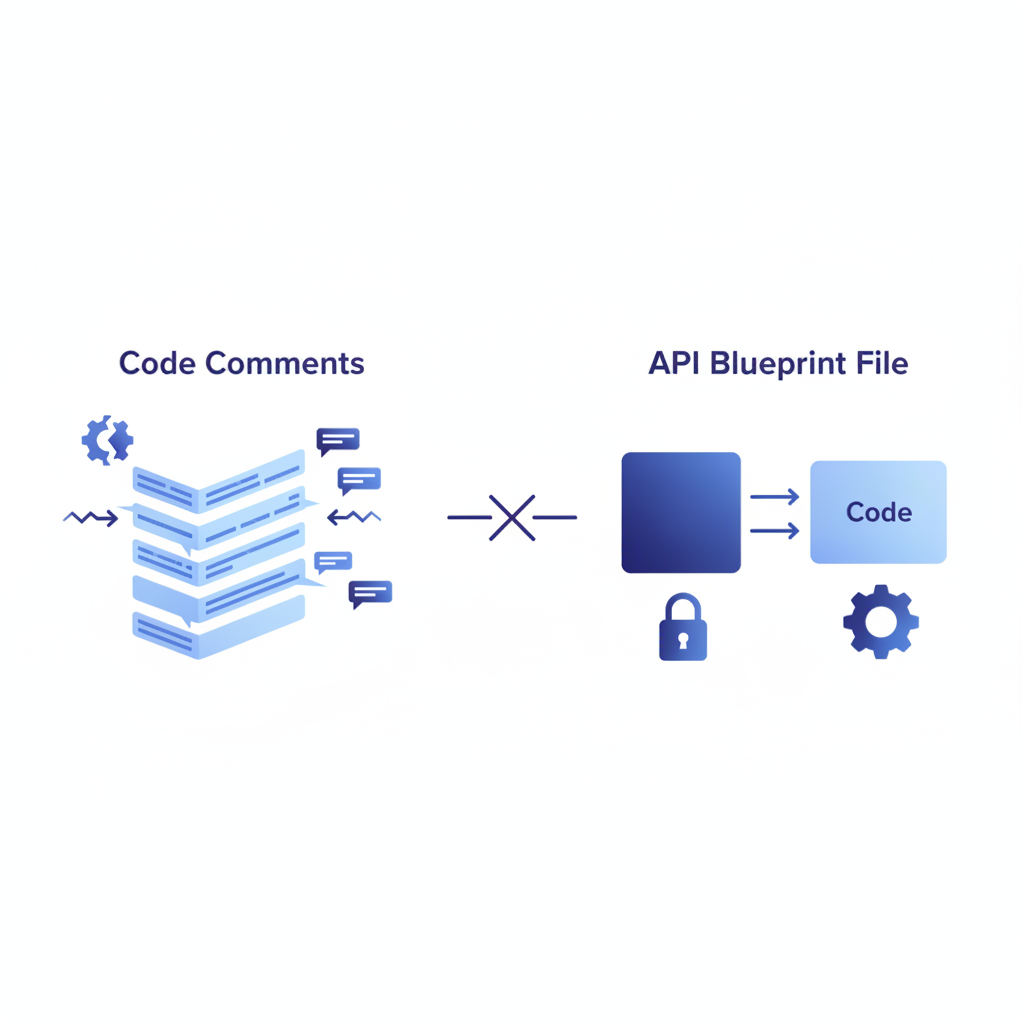
Generating API documentation from code comments means using annotations embedded in source code, such as JSDoc blocks in JavaScript or docstrings in Python, to automatically produce reference pages. Tools like JSDoc, Sphinx, or swagger-jsdoc parse these annotations and output HTML or JSON. Apidoke takes a different approach: you write in the open API Blueprint format in a live editor, and your documentation is always decoupled from your implementation code.
- Annotation-based generation (JSDoc, docstrings, Swagger annotations) works well for libraries and SDKs but struggles with REST HTTP semantics, status codes, and example bodies.
- Code-first docs go stale when the comment and the implementation drift apart, which is a very common failure mode in active codebases.
- API Blueprint is a dedicated description format that lets you specify exact HTTP requests and responses independent of any programming language, making your docs portable and verifiable.
- Apidoke publishes API Blueprint files as a live, interactive, three-column reference with a try-it console, and stores per-project version history so older readers always see the docs that match their API version.
What "generating docs from code comments" actually means
The phrase covers a few distinct techniques that developers often conflate.
Inline annotations (JSDoc, Javadoc, docstrings)
Inline annotations are structured comments placed directly above a function or class. A JSDoc block looks like this:
/**
 * Retrieve a user by their ID.
 * @param {string} id - The user's UUID.
 * @returns {Promise<User>} The user object.
 */
async function getUser(id) { ... }
JSDoc then generates an HTML page listing the function signature, parameter types, and return type. Python's Sphinx does the same from docstrings. These tools are very good at what they do: documenting the code surface of a library.
Swagger/OpenAPI annotations in route handlers
Frameworks like Express, FastAPI, and Spring can scan route decorators or JSDoc-style Swagger annotations and emit an OpenAPI 3.x JSON file. FastAPI does this automatically from Python type hints. Express-based tools like swagger-jsdoc require you to write full YAML blocks inside comment delimiters:
/**
 * @swagger
 * /users/{id}:
 *   get:
 *     summary: Get a user
 *     parameters:
 *       - in: path
 *         name: id
 *         required: true
 *         schema:
 *           type: string
 *     responses:
 *       '200':
 *         description: Success
 */
This is not really "auto-generation" in the magical sense. You are still writing documentation, just inside a comment block inside your route file. The tool extracts it and reformats it.
When code-comment generation genuinely works
| Use case | Annotation approach | Works well? |
|---|---|---|
| SDK or library reference (functions, classes, types) | JSDoc, Javadoc, Sphinx, TypeDoc | Yes, the primary use case |
| FastAPI or similar typed-Python REST API | Auto-generated OpenAPI from type hints | Yes, with good schema coverage |
| Internal microservice where devs read the source | Any annotation tool | Often good enough |
| Public REST API with rich example bodies, error codes, auth flows | swagger-jsdoc or similar | Partial, requires extensive manual annotation |
| API with multiple response variants (200, 201, 401, 404, 422) | Any annotation tool | Possible but verbose and fragile |
| Versioned public API, multiple simultaneous consumers | Any annotation tool | Difficult; docs and code versions often diverge |
The real failure modes developers hit
The comment drifts from the code
This is the most common problem. A developer changes a 200 response body to include a new metadata field, or renames a query parameter from limit to page_size, and forgets to update the annotation above the function. The test suite passes. The docs silently lie. Consumers hit a 400 Bad Request because they followed the old parameter name.
RFC 9110 defines 400 as "the server cannot or will not process the request due to something perceived to be a client error," but from the consumer's perspective the error looks like a documentation failure, not a code failure. (RFC 9110, Section 15.5.1)
HTTP semantics get second-class treatment
Code-comment tools were designed to document function calls, not HTTP conversations. Documenting the difference between a 201 Created response (which includes a Location header pointing to the new resource) and a 200 OK on a POST endpoint requires you to stuff YAML or structured text into a comment. It works, but it is unnatural. Developers routinely omit it because it feels like overhead.
Example request and response bodies are hard to maintain
A realistic JSON example body sitting inside a comment block is easy to accidentally break. A missing comma or a stray bracket is invisible to the language parser, so the build succeeds but the documentation example is malformed JSON. Consumers copy-paste it and get a 422 Unprocessable Entity.
The output is tied to one language and one codebase
If you rewrite a service from Node to Go, your JSDoc annotations disappear. If a second service owned by a different team needs to reference the same endpoint, they cannot reuse your annotation-generated docs in any portable way.
How API Blueprint compares as an alternative approach
API Blueprint is a Markdown-based, language-agnostic API description format maintained as an open specification. It lives in a .apib file alongside your code (or in a separate repository), not inside comment blocks. The two key structural units are Groups, which organize endpoints by domain, and Actions, which describe a single HTTP method on a Resource.
Here is a minimal but complete example covering a GET with a 200, a 401, and a 404:
FORMAT: 1A

# User API

## Group Users

### Get User [GET /users/{id}]

Returns a single user. Requires a valid Bearer token.

+ Parameters
    + id: `a3f2c1` (string, required) - UUID of the user

+ Request (application/json)
    + Headers

            Authorization: Bearer eyJhbGci...

+ Response 200 (application/json)
    + Body

            {
              "id": "a3f2c1",
              "email": "ada@example.com",
              "createdAt": "2025-01-15T08:30:00Z"
            }

+ Response 401 (application/json)
    + Body

            { "error": "unauthorized", "message": "Bearer token missing or expired" }

+ Response 404 (application/json)
    + Body

            { "error": "not_found", "message": "No user with id a3f2c1" }
Every response code, every header, and every JSON body is explicit and checkable. The format is plain text, so it diffs cleanly in Git and survives any language rewrite.
What Apidoke does with that Blueprint file
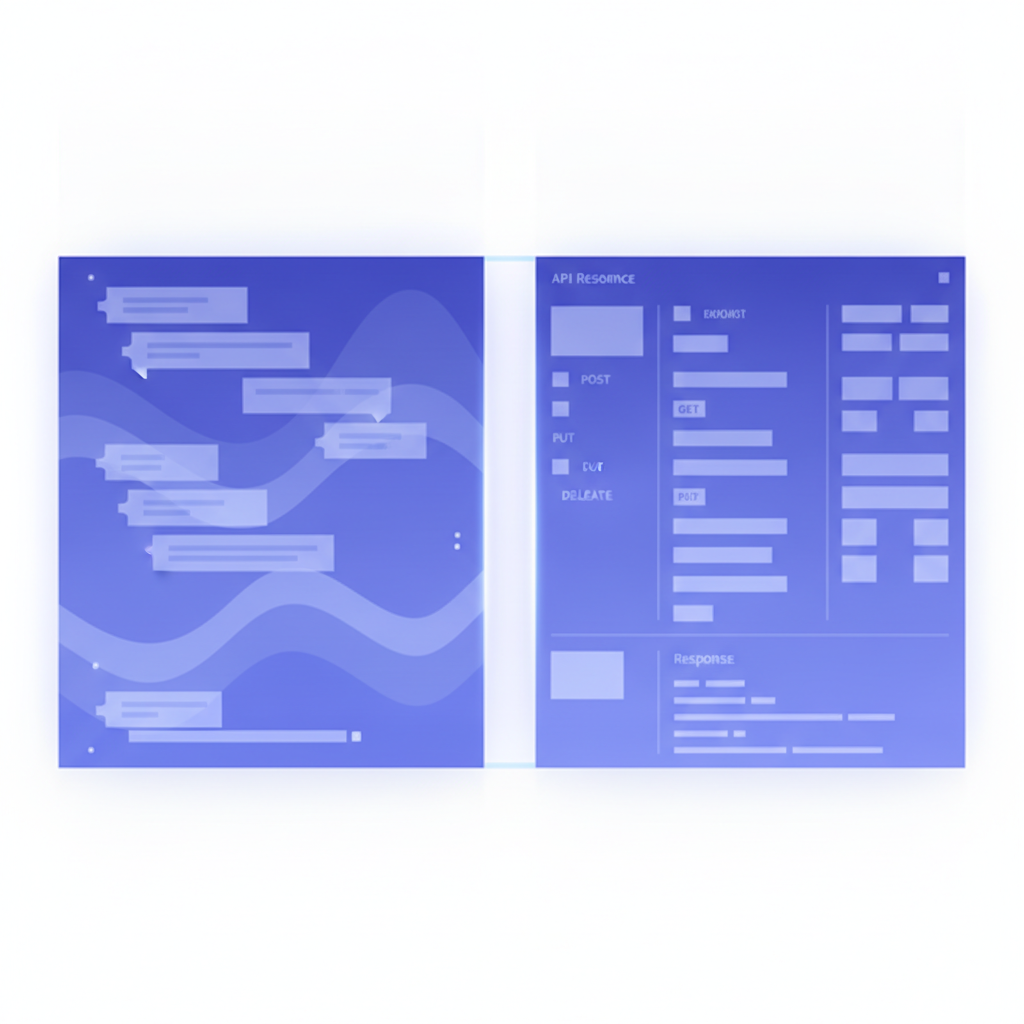
When you paste or write that .apib content in Apidoke's split-pane CodeMirror editor, the live preview renders the three-column reference in real time: navigation on the left, endpoint descriptions in the centre, and a try-it console on the right. The try-it console fires real HTTP requests from the browser. Auth tokens you enter (Bearer tokens, API keys) stay in the browser and never pass through Apidoke's servers, which matters for teams working with sensitive credentials.
Per-project version history means you can snapshot the docs at v1.0, keep editing toward v2.0, and give consumers a URL that will always show them the v1.0 reference. That is a problem annotation-based tools handle poorly, because the comments are tied to a specific commit of the implementation.
For the full walkthrough of authoring and publishing, see the guide on publishing your first interactive API doc with Apidoke.
A practical decision framework: which approach fits which situation?
- Identify your primary audience. If your consumers are other developers on the same team reading the source repo, inline annotations (JSDoc, docstrings) are probably sufficient. If you are publishing to external developers or multiple teams, a dedicated format file is cleaner.
- Count your response variants. If most of your endpoints have only a single success path and you rarely document 401 or 404 in detail, annotation tools are fine. If you need to document 200, 201, 400, 401, 403, 404, and 422 with distinct example bodies, API Blueprint gives you a much cleaner syntax.
- Assess your update frequency. Codebases that change quickly accumulate comment drift. A Blueprint file edited in a focused doc-authoring tool forces you to think about the HTTP contract separately from the implementation, which makes it easier to keep both accurate.
- Consider portability. If you think you might move to a different language, framework, or service boundary in the next year, annotation-based docs will not survive the migration. A
.apibfile survives any rewrite. - Check whether you need a live try-it console. No annotation-only tool ships one. You need either Swagger UI (for OpenAPI output) or a dedicated hosting tool. Apidoke includes the try-it console with no separate configuration.
Can you combine annotation generation with API Blueprint?
Yes, and some teams do exactly this. The workflow is: generate an OpenAPI spec from annotations (FastAPI, or swagger-jsdoc), use it as a reference for accuracy, and then write the audience-facing documentation in API Blueprint by hand. The Blueprint file is what you actually publish to consumers. The OpenAPI spec is an internal accuracy check.
This hybrid approach is more work upfront but produces documentation that is both accurate (because you can compare it against the generated spec) and readable (because you control the prose, examples, and structure). It also lets you add things the annotation generator cannot infer: conceptual context, error troubleshooting notes, authentication walkthroughs, and realistic multi-step example flows.
The maintenance question, honestly
Every documentation approach requires maintenance. Annotation tools trade the maintenance burden into the source files, which sounds good until you realize that code reviews rarely focus on comment accuracy. A PR that changes a response field from a string to an integer will get merged with no one checking whether the JSDoc annotation was updated.
API Blueprint files in a separate location are easier to review as documentation because they are documentation, not comments wrapped around code. Some teams add a check to their CI pipeline that fails if the .apib file was not touched when certain route files changed. The guide on continuous documentation in CI/CD covers patterns for keeping your Blueprint files in sync automatically.
Frequently asked questions
Can JSDoc generate REST API documentation automatically?
JSDoc generates documentation from function signatures and types, which works well for JavaScript libraries. For REST APIs you need to add Swagger/OpenAPI annotations manually inside JSDoc comment blocks using a tool like swagger-jsdoc. The output is an OpenAPI spec, not a truly automatic extraction of HTTP behaviour from your code.
What is the difference between code-first and design-first API documentation?
Code-first means you write the implementation and derive docs from it, typically via annotations. Design-first means you write the API description (in API Blueprint, OpenAPI, or similar) before or alongside the implementation. Design-first produces more accurate, audience-focused documentation because the description is the primary artefact, not a secondary output of the code.
Does Apidoke support importing OpenAPI or Swagger files?
Apidoke's authoring environment is built around the API Blueprint format. It does not import OpenAPI or Swagger files directly. If you have an existing OpenAPI spec you can use it as a reference while writing your API Blueprint documentation in Apidoke's editor.
How do I document response codes like 401 and 404 in API Blueprint?
In an API Blueprint action, add a + Response 401 (application/json) block followed by a + Body section containing your JSON example. You can add as many + Response blocks as you need under a single action, each with its own headers and body.
Will my API documentation break if I rewrite the service in a different language?
If your docs live in code comments, yes, they will likely be lost or orphaned in a rewrite. A .apib file stored separately from the implementation survives any language change because it describes the HTTP contract, not the code internals.
Start writing API docs that stay accurate
If you want documentation that is decoupled from your implementation, ships a live try-it console, and stores per-project version history out of the box, create a free Apidoke account at register for Apidoke and write your first API Blueprint file in the browser editor today.