
API Documentation Lifecycle: From Design to Deprecation
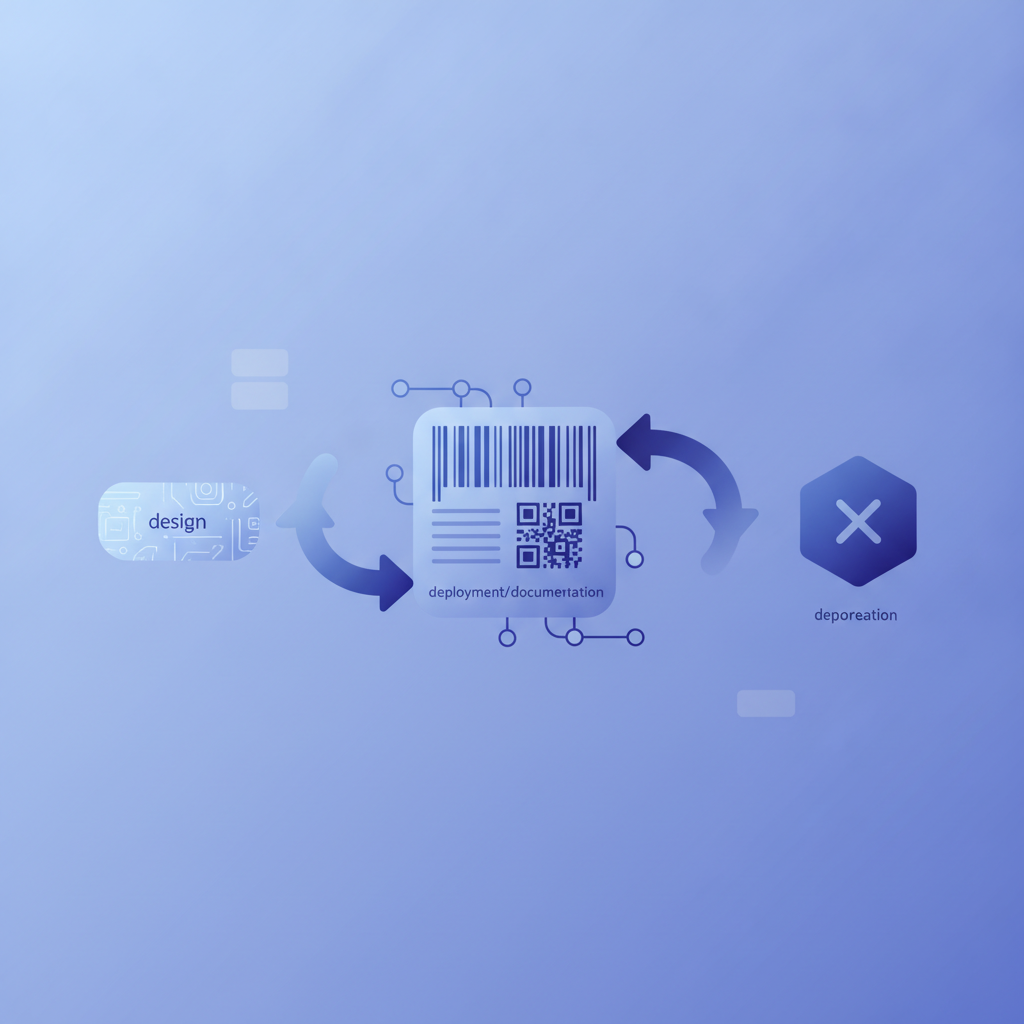
The API documentation lifecycle is the structured sequence of phases that every API and its accompanying documentation passes through, starting with design and specification, moving through initial publication, versioned updates, and ongoing maintenance, and ending when an endpoint or entire API version is formally deprecated. Apidoke is built to support the full arc: you author in API Blueprint, publish a live three-column reference with a try-it console, and track every revision through per-project version history.
- Documentation is not a post-launch task. In an API-first workflow, the spec comes before the implementation.
- Each lifecycle phase has distinct deliverables: a draft spec, a published reference, versioned changelogs, maintenance audits, and a deprecation notice.
- Skipping or compressing phases is the leading cause of stale, trust-breaking API docs.
- Apidoke's built-in version history, live preview editor, and self-hosted publishing let one person or a small team manage the entire lifecycle without assembling a separate toolchain.
What are the phases of the API documentation lifecycle?
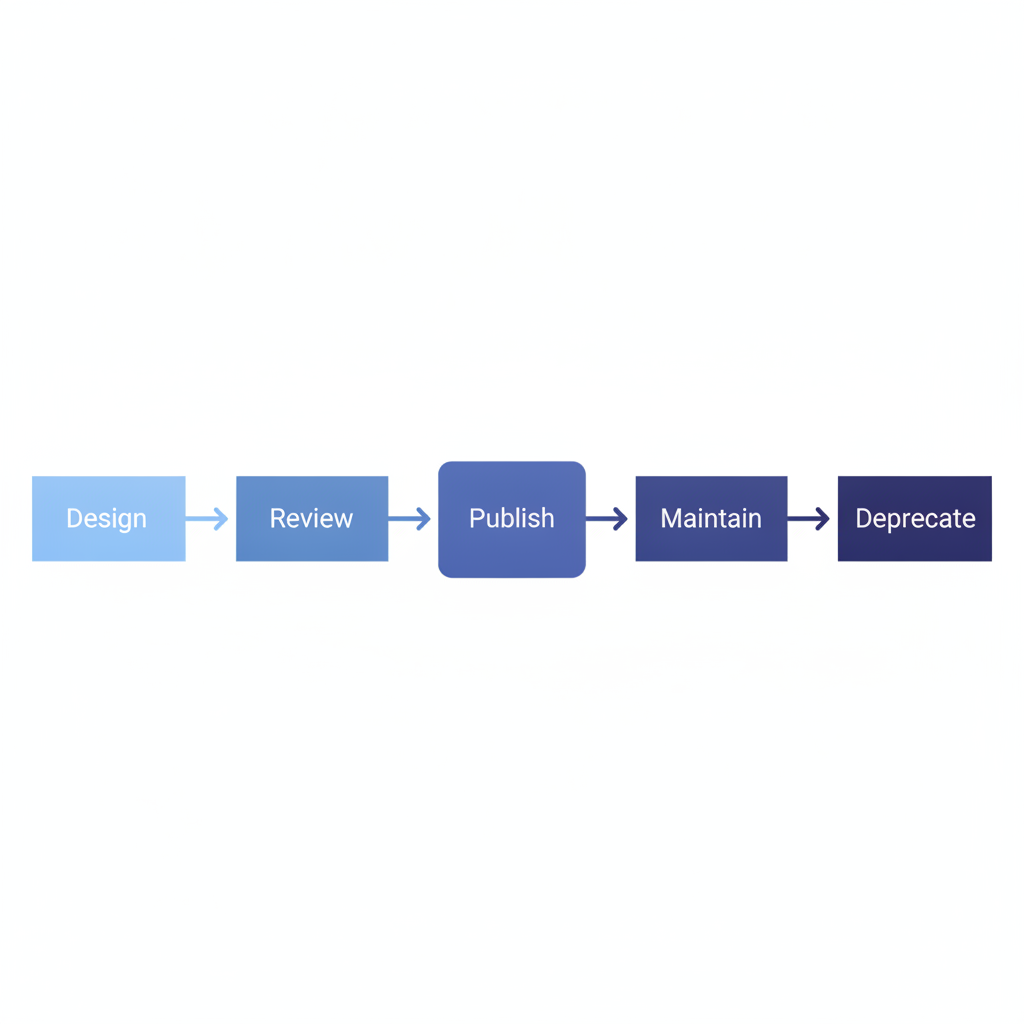
Most teams find it useful to split the lifecycle into five phases. The boundaries between them are real but porous: deprecation of one endpoint often coincides with the design phase for a replacement. The table below summarises the phases, their primary output, and the team role most responsible.
| Phase | Primary output | Key responsible role | Apidoke feature most used |
|---|---|---|---|
| 1. Design and specification | API Blueprint draft | API designer / backend engineer | Split-pane CodeMirror editor with live preview |
| 2. Review and approval | Reviewed, agreed spec | Tech lead / product manager | Version history snapshots for diff review |
| 3. Initial publication | Live public or private reference | Developer experience / DevRel | One-click publish to hosted or self-hosted URL |
| 4. Active maintenance | Updated docs, changelogs, versioned releases | Technical writer / engineering team | Version history, live preview, try-it console |
| 5. Deprecation and retirement | Deprecation notice, migration guide, sunset date | API owner / product manager | Version history (preserving deprecated version) |
Phase 1: Design and specification
The design phase is where the API documentation lifecycle begins, and it starts earlier than most teams expect. API-first design means the specification is the source of truth. Engineers and designers agree on resource shapes, URL structures, and error contracts in the doc before any server code is written. This prevents the common trap of documentation that is permanently one sprint behind the implementation.
Writing the first Blueprint draft
API Blueprint (defined at apiblueprint.org) is a Markdown-based language for describing REST APIs. A minimal but complete starting point for a new resource looks like this:
FORMAT: 1A
HOST: https://api.example.com

# Payments API

## Group Payments

### Create a Payment [POST /payments]

Create a new payment intent.

+ Request (application/json)

    + Attributes
        + amount: 2500 (number, required) - Amount in the smallest currency unit (e.g. cents)
        + currency: `usd` (string, required) - ISO 4217 currency code

    + Body

            {
              "amount": 2500,
              "currency": "usd"
            }

+ Response 201 (application/json)

        {
          "id": "pay_01HXZ4K",
          "status": "pending",
          "amount": 2500,
          "currency": "usd"
        }

+ Response 400 (application/json)

        {
          "error": "invalid_currency",
          "message": "Currency must be a valid ISO 4217 code."
        }
Even this small fragment captures the HTTP method (POST), the path (/payments), the expected request body shape, and two possible responses (201 Created and 400 Bad Request). That is enough for a frontend engineer to build a mock client before the backend exists. Apidoke's editor renders this in the live preview pane the moment you stop typing.
What to settle during design
Before moving to review, the draft should answer four questions: What HTTP methods and paths does the API expose? What does each request body require (types, required fields, constraints)? What status codes does each action return, including error cases? What authentication scheme does the API use (API key, Bearer token, OAuth 2.0)?
Leaving any of these unresolved pushes ambiguity into the implementation, where it is expensive to fix.
Phase 2: Review and approval
A specification that has not been reviewed is a guess. The review phase turns a draft into a contract. The process does not need to be heavyweight. At a minimum, one engineer who did not write the spec should attempt to build a client from it without asking questions. If they cannot, the spec has gaps.
Using version history as a review artifact
Apidoke saves a snapshot every time you save a project. During review, you can share a specific snapshot URL with reviewers. They can compare it against previous snapshots to see exactly what changed. This beats emailing Markdown files around, and it means the approval trail lives next to the spec itself rather than in a separate Jira ticket or email thread.
Common review failures to catch early
- Missing 401 and 403 responses on authenticated endpoints
- Inconsistent naming (user_id in one resource, userId in another)
- Undocumented pagination on collection endpoints that return arrays
- No example values for enum fields (a list like
status: active | paused | archivedis far more useful thanstatus: string)
The API documentation review checklist covers each of these points in depth with a full team workflow.
Phase 3: Initial publication
Publication transforms the approved spec from a document shared among the team into a resource available to consumers. This is the most visible moment in the lifecycle, and the bar for quality is higher than it is during design.
What a published reference must include on day one
At minimum, every published reference should have: a short introduction that explains what the API does and who it is for; authentication instructions with a copy-paste example; at least one complete request/response pair per endpoint, including error responses; and a base URL that is correct for the environment consumers will use.
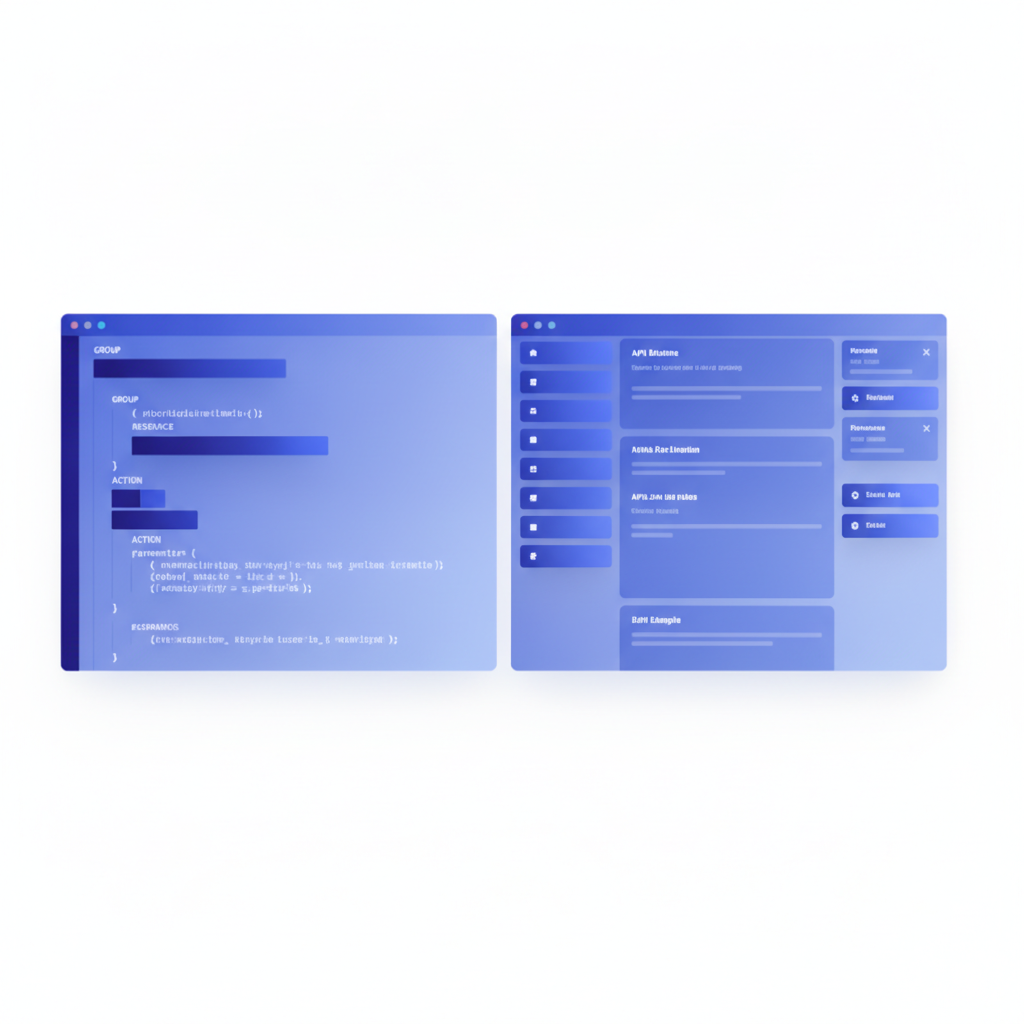
In Apidoke, publishing is a single action. The result is a three-column layout: navigation on the left, endpoint documentation in the centre, and a live try-it console on the right. The console fires real HTTP requests directly from the browser. Auth tokens entered into the try-it console are never sent to Apidoke's servers; they go from the browser directly to your API, which matters when consumers are testing against a production endpoint with real credentials.
Public versus private publication
Apidoke supports publishing a project to a public URL or keeping it accessible only to those with the link. For internal APIs, keeping docs private reduces the risk of leaking internal resource shapes. For public APIs, an openly accessible reference lowers the support burden immediately. The choice should be made deliberately at this phase, not discovered later when someone stumbles across your docs in a search result.
Phase 4: Active maintenance
Most of an API's life is spent in this phase. Active maintenance is where the lifecycle earns its name: the work is continuous, iterative, and driven by changes to the API itself, feedback from consumers, and evolution in the product.
Keeping documentation in sync with the implementation
The single most common documentation failure is drift: the API changes but the docs do not. The most effective defence is treating documentation updates as part of the same pull request as the API change. Continuous documentation in a CI/CD pipeline formalises this by making a failing doc check block a merge.
Even without CI/CD integration, Apidoke's version history makes drift visible. If the last saved snapshot is six months old and your API has shipped twelve releases since then, that gap is obvious. Regular saves create a natural audit trail.
Versioning your documentation as your API versions
When a breaking change requires a new API version (say, moving from /v1/payments to /v2/payments), the documentation for each version should be preserved independently. In Apidoke, you create a separate project for the new version and retain the previous project so consumers still on v1 can reference its documentation while they migrate. API versioning strategies covers the trade-offs between URL versioning, header versioning, and media-type versioning in detail.
Writing changelogs and release notes during maintenance
Every meaningful change to a published API should produce a changelog entry. A good entry names the endpoint affected, describes what changed and why, states whether the change is breaking, and links to the updated reference. For example:
## 2026-06-15

### Changed
- `POST /payments` now requires `currency` to be lowercase. Previously
  uppercase values such as `USD` were accepted; they now return 422.
  Update your client to pass lowercase ISO 4217 codes (e.g. `usd`).

### Added
- `GET /payments/{id}/events` returns a paginated list of status
  transitions for a payment. See the Payments reference for parameters.
Specific, honest, and immediately actionable. The API changelog best practices guide provides a full structure including semantic versioning alignment and what to do when a change is unintentionally breaking.
Scheduled documentation audits
Maintenance should include periodic audits, not just reactive updates. A quarterly audit reviews every endpoint against the actual API behaviour, checks that all example request bodies still return the documented responses, and removes or updates any references to deprecated fields. The API documentation audit guide provides a step-by-step process for running one.
Phase 5: Deprecation and retirement
Deprecation is the final phase, and it is often handled worse than any other. Done poorly, it breaks client integrations without warning. Done well, it is a demonstration of professionalism that strengthens developer trust even as a feature is removed.
What deprecation actually means in HTTP terms
HTTP itself has a formal mechanism for signalling deprecation. The Deprecation response header (defined in RFC 8594) lets a server attach a deprecation date to any response. A client that sees this header knows the endpoint will stop working. The Sunset header carries the specific date after which the endpoint will return 410 Gone. Your documentation should describe both headers and show what a response looks like in transition:
HTTP/1.1 200 OK
Deprecation: Sat, 01 Jan 2027 00:00:00 GMT
Sunset: Sat, 01 Jan 2027 00:00:00 GMT
Link: <https://api.example.com/v2/payments>; rel="successor-version"
Content-Type: application/json

{
  "id": "pay_01HXZ4K",
  "status": "pending"
}
Writing the deprecation notice in your API Blueprint spec
Before the sunset date, add a visible deprecation warning to the affected endpoint in your Blueprint. Keep the full endpoint documentation intact so existing consumers can still reference it. Add a prominent note at the top of the action block:
### Create a Payment (v1) [POST /v1/payments]

::: warning
**Deprecated.** This endpoint will stop accepting requests on 2027-01-01.
Please migrate to [POST /v2/payments](#reference/payments/create-a-payment-v2)
before that date.
:::

+ Request (application/json)
    ...
Apidoke renders the warning block as a styled callout in the three-column view, so consumers see it immediately when they open the reference. The endpoint stays in the navigation until you are ready to remove it after retirement.
What to include in a formal deprecation notice
- The exact endpoint or endpoints being deprecated (method and path, e.g.
GET /v1/users/{id}). - The sunset date: a specific calendar date, not a vague phrase like "in a few months".
- The reason for deprecation, explained honestly. Consumers respect transparency.
- The replacement: the new endpoint or approach, with a link to its documentation.
- A migration checklist or code example showing the before and after.
- A contact point (email or issue tracker) for questions.
Preserving deprecated documentation
Do not delete deprecated documentation before the sunset date. Consumers mid-migration still need the old reference. In Apidoke, you can maintain a separate project (or a named snapshot) for the deprecated version and link to it from the current version's introduction with a clear label. After the sunset date passes and traffic to the old endpoint drops to zero, you can archive the project. The version history preserves a permanent record without cluttering your active documentation.
How documentation governance ties the lifecycle together
Without governance, the lifecycle phases happen inconsistently across teams and projects. Governance means assigning a named owner to each API documentation project, defining what triggers an update (a merged pull request, a new version tag, a support ticket about confusing docs), setting a minimum review cadence, and agreeing on what a complete, shippable doc looks like.
This does not need to be bureaucratic. A single Markdown file in your repository that lists the doc owner, the last review date, and the next scheduled review is enough for a small team. The discipline of maintaining that file matters more than the format. For a fuller framework including policies and audit cycles, the API documentation governance guide covers each element in depth.
A worked example: one endpoint across the full lifecycle
To make this concrete, here is what a single endpoint looks like at each phase.
| Phase | What exists in the doc | What the try-it console returns |
|---|---|---|
| Design | POST /payments draft with request body and 201/400 responses | Nothing yet (endpoint not live) |
| Review | Same spec, plus 401 and 422 responses added after review | Nothing yet |
| Publication | Polished intro, authentication section, full request/response examples | 201 Created with real payment ID |
| Maintenance (v1) | Changelog noting currency field now requires lowercase; 422 added | 422 Unprocessable Entity for "USD", 201 for "usd" |
| Deprecation | Warning callout, sunset date 2027-01-01, link to POST /v2/payments | 200 OK with Deprecation and Sunset headers visible in response panel |
Maintenance cadences: how often to check your docs
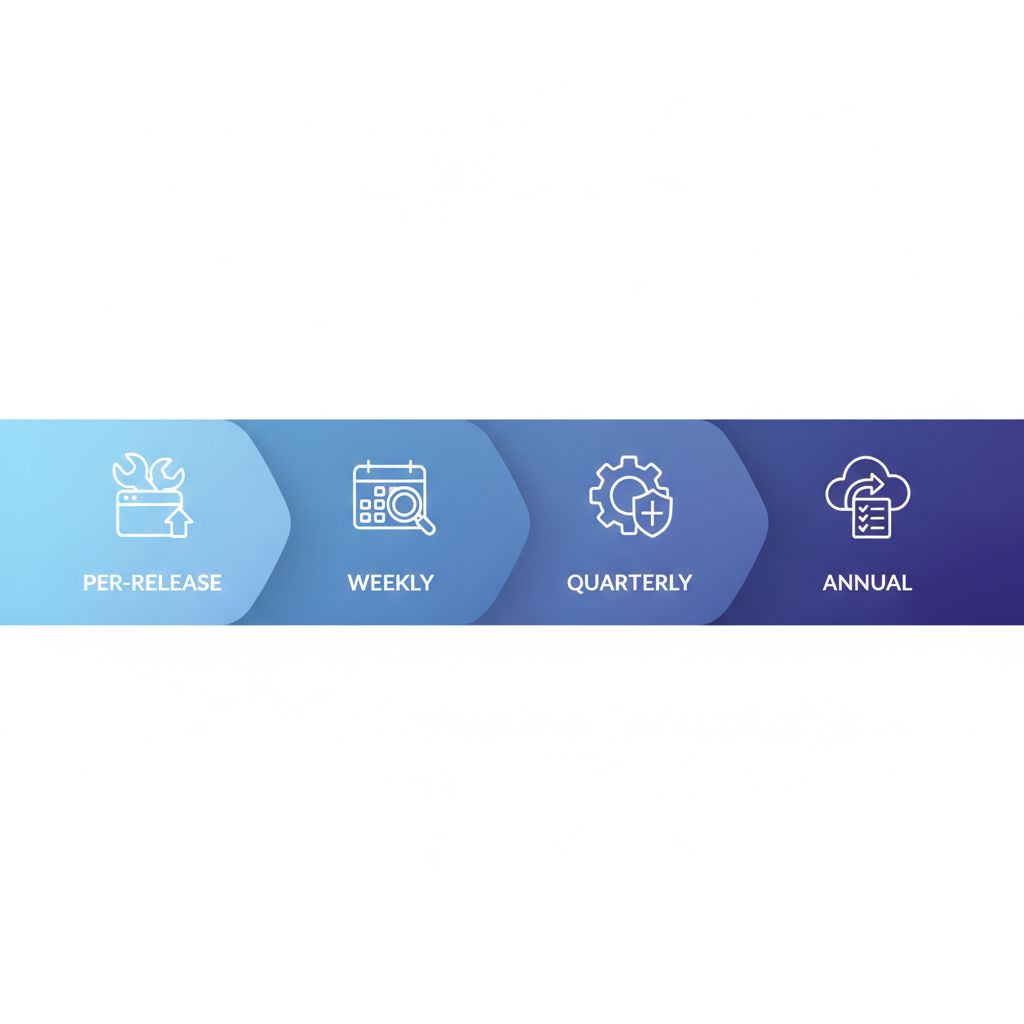
A practical maintenance program runs on four rhythms. Each one targets a different layer and requires a different kind of attention.
| Cadence | Trigger | What to check | Who owns it |
|---|---|---|---|
| Per-release | Every API version tag or deploy | New endpoints, changed parameters, new or removed response fields, updated error codes | Engineer shipping the change |
| Weekly | Standing meeting or async review slot | Open doc issues, try-it console failures, broken internal links | Tech writer or DX lead |
| Quarterly | Calendar, independent of release schedule | Code samples, authentication flows, pagination docs, error catalog completeness | Team or rotating owner |
| Annual | Calendar | Information architecture, navigation depth, deprecated endpoint cleanup, style guide alignment | DX lead or product owner |
The per-release cadence is the highest leverage. If you catch a change at the moment it ships, the cost of updating docs is near zero. If you catch it three months later, you have developer bug reports, confused support tickets, and a trust deficit to repair.
What to actually check at each cadence
Per-release: trace every HTTP surface change
When a release ships, walk through the diff of what changed at the HTTP surface level. For each change, ask three questions:
- Is the endpoint documented at all? If a new
POST /invoices/{id}/voidroute was added, does a corresponding API Blueprint resource and action exist? - Do the documented request parameters match what the server actually accepts? Check required vs optional, data types, and allowed values.
- Do the documented response bodies match what the server returns? Pay special attention to new fields and to fields that changed from nullable to required or vice versa.
Here is a concrete API Blueprint snippet showing what a properly maintained action looks like after a field is added to the response:
## Void Invoice [POST /invoices/{id}/void]

Marks an invoice as void. The invoice must be in `open` status.

+ Parameters
    + id: `inv_abc123` (string, required) - The invoice identifier.

+ Request (application/json)
    + Headers

            Authorization: Bearer {token}

+ Response 200 (application/json)
    + Attributes
        + id: `inv_abc123` (string) - Invoice ID.
        + status: `voided` (string) - Always `voided` on success.
        + voided_at: `2025-06-01T12:00:00Z` (string) - ISO 8601 timestamp. Added in v2.4.

+ Response 409 (application/json)
    + Body

            {
              "error": "invalid_status",
              "message": "Invoice must be in open status to be voided."
            }
Notice the inline note Added in v2.4 on the voided_at field. That annotation costs one second to write and saves a developer from filing a confused bug report six weeks later.
Weekly: verify the try-it console returns expected responses
A live try-it console is one of the fastest ways to catch doc drift. If your docs say a GET /products endpoint returns a 200 OK with a data array, but the server now returns a paginated envelope with a results key, the console will show the mismatch immediately. Fire three or four representative requests each week: one happy path, one that should return a 401 Unauthorized (missing or invalid token), one that should return a 404 Not Found (nonexistent resource ID), and one that should return a 422 Unprocessable Entity or 400 Bad Request (malformed body).
Apidoke's try-it console sends requests directly from the browser to your API server. Auth tokens stay in the browser session and are never routed through Apidoke's servers, which means you can safely test production endpoints with real credentials during your weekly check.
Quarterly: audit code samples and authentication docs
Code samples age faster than prose because they include specific field names, header values, and base URLs. A quarterly pass should check:
- Do all curl examples use the current base URL and the current required headers?
- Do authentication code samples reflect the current token endpoint, scopes, and expiry behavior?
- Are rate limit values in the docs still accurate? A common mistake is documenting
100 requests per minuteafter the limit was quietly raised or lowered. - Does the error catalog cover every
4xxand5xxcode the API actually returns?
The quarterly check is also a good moment to compare your docs against your API style guide. Naming conventions drift over time; one engineer documents a new field as createdAt while the rest of the API uses created_at. A quarterly style pass catches inconsistencies before they spread.
Annual: structural review and deprecated endpoint cleanup
Once a year, zoom out. Is the navigation structure still sensible? Does the grouping in your API Blueprint still match how developers think about the product? Are there endpoints marked deprecated in the docs that should now be removed entirely? According to the API Blueprint specification, a # Group is the primary organizational unit; if your groups were defined two years ago for a much smaller API, they may no longer map to how users navigate.
Compare the current blueprint with the version from 12 months ago in Git (Apidoke's in-app history keeps the last 50 saves, which may not reach back a full year). The structural differences are often easier to see across a year than across a sprint.
How to catch response body drift before your developers do
Response body drift, where the actual JSON shape diverges from what the docs describe, is the most common and most damaging form of doc rot. You cannot always prevent it, but you can detect it quickly with a simple manual protocol.
- Pick five representative endpoints that cover the main resource types (collection list, single resource, create, update, delete).
- Send a real request to each endpoint using the try-it console or curl.
- Copy the actual response body.
- Open your API Blueprint in Apidoke's editor and compare the documented response body against the real one, field by field.
- For any field that appears in the real response but not in the docs, add it. For any field documented but absent from the real response, investigate before removing (it may be conditionally returned).
Here is what a drift-corrected response section looks like in API Blueprint after you discover the server started returning an updated_by field:
+ Response 200 (application/json)
    + Body

            {
              "id": "prod_789",
              "name": "Widget Pro",
              "price": 4999,
              "currency": "usd",
              "updated_at": "2025-05-20T09:15:00Z",
              "updated_by": "user_456"
            }
Adding that one field takes 30 seconds. Missing it means every developer who reads the docs will build a data model without updated_by, then be confused when it appears in production responses.
Quick-reference: the maintenance health checklist
Use this list at each cadence as a literal pass/fail checklist.
| Check | Per-release | Weekly | Quarterly | Annual |
|---|---|---|---|---|
| New endpoints documented | Yes | |||
| Changed parameters updated | Yes | |||
| Response bodies match real API | Yes | Spot check | Full pass | |
| Error codes (400, 401, 404, 422, 500) documented | Yes | |||
| Try-it console returns expected status codes | Yes | |||
| Code samples use current base URL and headers | Yes | |||
| Authentication docs reflect current token flow | Yes | |||
| Rate limit values accurate | Yes | |||
| Deprecated endpoints removed or flagged | Yes | |||
| Navigation and group structure reviewed | Yes | |||
| Style guide compliance checked | Yes |
Frequently asked questions
When should I start writing API documentation?
Before the implementation, not after. In an API-first workflow, the specification is written and reviewed during the design phase, while the implementation is still in progress. This means consumers (and your own frontend team) can build against a stable contract without waiting for the backend to ship.
How do I handle documentation for breaking changes?
Breaking changes require a new documented version, a prominent changelog entry that explicitly labels the change as breaking, and a migration guide showing what code needs to change. Keep the old version's documentation live until the sunset date so consumers mid-migration have a reference. The Sunset HTTP header on API responses can reinforce the timeline at the protocol level.
How long should deprecated API documentation stay published?
At minimum, until the sunset date. In practice, keeping it accessible for three to six months after the sunset date costs nothing and spares you support requests from teams who missed the notice. Archive it rather than deleting it so the historical record is preserved.
What is the difference between deprecation and retirement?
Deprecation is a formal announcement that an endpoint will stop working on a specific date. During the deprecation window, the endpoint still functions and documentation remains live. Retirement is when the endpoint actually stops accepting requests (typically returning 410 Gone) after the sunset date passes.
Can one person manage the full API documentation lifecycle?
Yes, for most teams. A single engineer or technical writer can handle design, review, publishing, maintenance, and deprecation if the tooling does not get in the way. Apidoke is intentionally scoped for this: one editor, one publish action, one place to track version history, no separate build pipeline or hosting configuration required.
Ready to manage your API documentation lifecycle without assembling a toolchain? Create a free Apidoke account and publish your first versioned, interactive API reference in minutes.
How often should API documentation be updated?
At minimum, every time the API surface changes: new endpoints, changed parameters, updated response fields, or new error codes all require a doc update before or at the moment the change ships. On top of that, a weekly spot-check of the try-it console and a quarterly review of code samples and authentication flows catches the drift that per-release checks miss.
How do I know when an API response body has changed without being told?
The most reliable method is to fire real requests using your docs' try-it console or curl and compare the actual response body against your documented example, field by field. If a field appears in the real response that is absent from the docs, or vice versa, the docs need updating. Doing this for five representative endpoints each week takes less than 15 minutes.